4-H Science Blast Activities: Go Fish
DOWNLOADNovember 4, 2026 - Michigan State University Extension
 Print
 Email
Educational Elements
Key Concepts:
Habitat, life requirements
Subjects:
Science, math, social studies
Success Indicator:
After completing this lesson, learners will be able to:
- Identify and describe food, water and shelter as three essential components of habitat.
- Describe the importance of good habitat for fish.
- Define the term “limiting factors” and give examples.
- Recognize that fluctuations in fish populations occur because ecological systems undergo many changes.
- Describe how fishing is a positive tool for fisheries management.
Preparation Time:
10 minutes
Lesson Time:
30 minutes
Space:
Large area outside (20- by 30-foot area for running) or a gym or large hallway
Materials:
- Newsprint pad (flip chart) and markers, or chalkboard and chalk
- Sticky notes (medium to large)
Background Information:
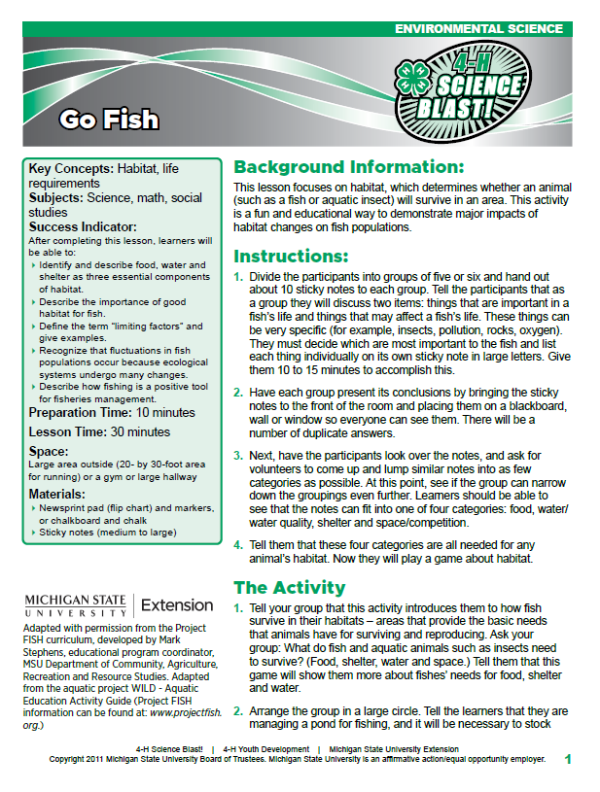
This lesson focuses on habitat, which determines whether an animal (such as a fish or aquatic insect) will survive in an area. This activity is a fun and educational way to demonstrate major impacts of habitat changes on fish populations.
Instructions:
- Divide the participants into groups of five or six and hand out about 10 sticky notes to each group. Tell the participants that as a group they will discuss two items: things that are important in a fish’s life and things that may affect a fish’s life. These things can be very specific (for example, insects, pollution, rocks, oxygen). They must decide which are most important to the fish and list each thing individually on its own sticky note in large letters. Give them 10 to 15 minutes to accomplish this.
- Have each group present its conclusions by bringing the sticky notes to the front of the room and placing them on a blackboard, wall or window so everyone can see them. There will be a number of duplicate answers.
- Next, have the participants look over the notes, and ask for volunteers to come up and lump similar notes into as few categories as possible. At this point, see if the group can narrow down the groupings even further. Learners should be able to see that the notes can fit into one of four categories: food, water/water quality, shelter and space/competition.
- Tell them that these four categories are all needed for any animal’s habitat. Now they will play a game about habitat.
The Activity:
- Tell your group that this activity introduces them to how fish survive in their habitats – areas that provide the basic needs that animals have for surviving and reproducing. Ask your group: What do fish and aquatic animals such as insects need to survive? (Food, shelter, water and space.) Tell them that this game will show them more about fishes’ needs for food, shelter and water.
- Arrange the group in a large circle. Tell the learners that they are managing a pond for fishing, and it will be necessary to stock (add fish) to get the game started. The center of the circle is the playing area and the fourth component of habitat, space. Choose two to four participants to become the stocked fish and send them to one side of the circle. The other members of the group are habitat and go together to the other side of the circle. Mark two parallel lines on the ground about 20 feet apart. Have the fish line up behind one line and the rest (habitat) behind the other line.
- The fish need to find food, water and shelter. When a fish is looking for food, it should clamp its hands over its stomach. When looking for water, it moves its hands to its cheeks to imitate water moving through gills. When looking for shelter, it holds its hands together over its head. A fish can choose to look for any one of its needs during each round of the activity.
- Those playing the role of habitat also need to choose which component of habitat they will be: food, water or shelter. The habitat participants then make the sign showing which component of habitat they have chosen to be.
- The game starts with all players lined up on their respective line with their backs turned toward those on the other line.
- The group leader begins the first round by asking all the players to choose what they will be . Players on the habitat side of the game choose what habitat element they represent (food, water or shelter). Players on the fish side of the game choose what habitat element they need at that particular time (food water or shelter), and then make that sign.
- Tell the players that a fish cannot change what it is looking for once it has seen what is available. Remind the players to keep doing their signs until they have found a match. When you see that the players are ready, count “One... two... three... go fish.” At that point, the players turn to face one another while they continue to show off their hand signs.
- When the fish see the habitat component they need, they are to move to it and tag it. Each fish must hold the sign until getting to the habitat person with the same sign. Each fish that reaches its necessary habitat component takes that component back to the fish side. When two or more fish reach a habitat component, the fish who gets the habitat item first survives.
Any fish that fails to find its food, water or shelter dies and becomes part of the habitat in the next round. The fish that has died is now a habitat component and so is available as food, water or shelter to the fish that are still alive.
Habitat components stay in place on their line until a fish tags them. If no fish needs a particular habitat component during a round, the habitat component just stays where it is in the habitat line. The habitat person can change which component he/she is from round to round but not after seeing what the fish signs are. Many kids would rather be fish, so this rule is important!
Point out to the players that, as habitat declines, competition to gain the needed things for survival will increase. Remind the group that pushing and shoving will not be tolerated. - The group leader or helper (playing the role of a fisheries biologist) keeps track of how many fish there are at the beginning of the game (that is, year one) and at the beginning of each round
(years two, three, four and so on).
Participants eventually will use these numbers to create a graph with number of years on the X axis (horizontal) and number of fish on the Y axis (vertical). - At the end of at least five rounds, gather the players together to discuss the activity and the graph. (This can be done indoors, individually or as a group.) Encourage them to talk about what they saw. For example, ask them to describe how the numbers of fish changed over time.
Ideally, the players will recognize that they saw a small population of fish finding more than enough resources to meet habitat needs. Then the population of fish expanded during the next two to three rounds (years) of the game until the habitat was depleted and there wasn’t enough food, water and shelter for all the members of the population of fish. At that point, some fish died from starvation, didn’t have good water or lacked shelter. These are called limiting factors -- the condition or amount of something that limits the number or distribution of a particular organism. When the fish died, they returned nutrients to the habitat. - Now add an angler to the game. Have the angler stand at the side, between the fish and the habitat. Allow the angler to catch a specified number of fish by touching them before they get to the habitat (for example, the pond owner sets a fishing limit of two fish, as a rule). This version of the game will introduce the concept of fisheries management involving fishing.
After the round, the angler can choose to keep and eat the fish (returning them to habitat) or release them back to be fish again. Ask the players: What would have happened if no fishing limit (regulation) was imposed? What would happen if the habitat completely lacked one component of habitat (such as food)? (The population would “crash.”) End
by explaining to the players that fish populations depend greatly on their habitats, and that, to take the best care of our resources, we and biologists need to understand not only the fish but all of the things in the habitat that fish need to survive and reproduce.
Tips for Success
Safety first! Clear the playing area of stones or other debris before playing. Remind players to be careful while running.
It is helpful to have adult or teen observers help with the game. Have any participants who can’t run play the role of the fish biologists and record data.
Play various versions of the game. Introduce predators and other mortality factors. Have players create their own adaptations. Devise a way to introduce into the game the concept of carrying capacity (the maximum and/or average number of a given organism that an area can maintain at a particular season of the year).
Ways to Extend:
Follow up the activity by contacting your local Michigan Department of Natural Resources office to learn about local fish population trends. Invite a biologist to speak at your next class or club meeting.
Community Service Learning:
- Older participants can teach the concepts in this lesson to younger groups. For example, teens could volunteer to lead this game at an elementary or middle school, scout meeting or youth camp.
- Work with a local biologist to improve the quality of the aquatic habitat in local lakes, rivers or streams.
Exhibits/Sharing:
Create a display about how fish populations change over time as habitat changes. Explain to community members the reasons to be good stewards of our water ecosystems.