4-H Science Blast Activities: Best Lettuce Experiment
DOWNLOADNovember 5, 2026 - Michigan State University Extension
 Print
 Email
Educational Elements
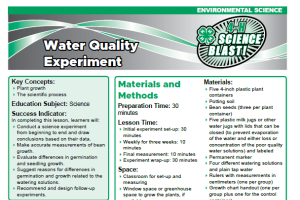
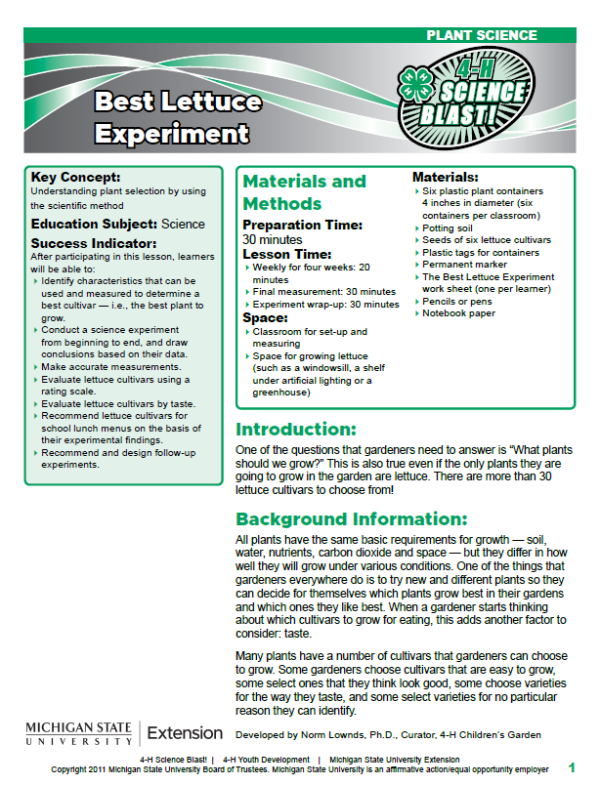
Key Concept:
Understanding plant selection by using the scientific method
Education Subject:
Science
Success Indicator:
After participating in this lesson, learners will be able to:
- Identify characteristics that can be used and measured to determine a best cultivar — i.e., the best plant to grow.
- Conduct a science experiment from beginning to end, and draw conclusions based on their data.
- Make accurate measurements.
- Evaluate lettuce cultivars using a rating scale.
- Evaluate lettuce cultivars by taste.
- Recommend lettuce cultivars for school lunch menus on the basis of their experimental findings.
- Recommend and design follow-up experiments.
Materials and Methods
Preparation Time: 30 minutes
Lesson Time:
- Weekly for four weeks: 20 minutes
- Final measurement: 30 minutes
- Experiment wrap-up: 30 minutes
Space:
- Classroom for set-up and measuring
- Space for growing lettuce (such as a windowsill, a shelf under artificial lighting or a greenhouse)
Materials:
- Six plastic plant containers 4 inches in diameter (six containers per classroom)
- Potting soil
- Seeds of six lettuce cultivars
- Plastic tags for containers
- Permanent marker
- The Best Lettuce Experiment work sheet (one per learner)
- Pencils or pens
- Notebook paper
Introduction:
One of the questions that gardeners need to answer is “What plants should we grow?” This is also true even if the only plants they are going to grow in the garden are lettuce. There are more than 30 lettuce cultivars to choose from!
Background Information:
All plants have the same basic requirements for growth — soil, water, nutrients, carbon dioxide and space — but they differ in how well they will grow under various conditions. One of the things that gardeners everywhere do is to try new and different plants so they can decide for themselves which plants grow best in their gardens and which ones they like best. When a gardener starts thinking about which cultivars to grow for eating, this adds another factor to consider: taste.
Many plants have a number of cultivars that gardeners can choose to grow. Some gardeners choose cultivars that are easy to grow, some select ones that they think look good, some choose varieties for the way they taste, and some select varieties for no particular reason they can identify.
Scientists will select cultivars on the basis of testing various plants and deciding which varieties best do what they’re supposed to do. That could mean that the plants grow the tallest, they require the least amount of water, they don’t have diseases or they taste the best. Scientists experiment to figure out which cultivar is the best for the characteristic they’re studying.
As school gardens become more common and the vegetables grown in them are added to the school lunch program, school gardeners must decide which cultivars to grow. It seems only natural that students should have input into this process. Therefore, the Best Lettuce Experiment — in which students grow, collect data on, evaluate and recommend lettuce cultivars — was developed to give students the opportunity to grow lettuce, evaluate it and make recommendations based on their data to best meet their needs and preferences. Use this opportunity to have students do an authentic experiment, much as the scientists at Michigan State University do.
Instructions:
Preparation Time:
- Gather the supplies from the materials list.
- Make one photocopy of the Best Lettuce Experiment work sheet for each student.
Starting the experiment:
- Have the students brainstorm answers to the questions in the
“Ask a Question” portion of the Best Lettuce Experiment work sheet, either in groups or as a whole-class discussion. - Have the students read and then briefly discuss as a class
the “Research” part of the work sheet. If possible, expand this discussion by having the students research particular salad greens to determine which are the most nutrient-dense. - Give the students a few minutes to complete the “Hypothesis” section of the work sheet, then ask for volunteers to explain their hypotheses.
- Have students read and briefly discuss the “Design Experiment” part of the worksheet. Then have them write the names of the cultivars they’ll be growing in the experiment in the appropriate space on their work sheets. Ask them why items 2-6 are so important.
- Have them discuss and name several additional salad green characteristics they’d like to measure as part of the experiment and write them on the work sheet.
- Divide the class into groups, one group for each lettuce cultivar you have for them to grow. Give the groups a few minutes to decide on a group name, then give each group a plant container and a seed package. Pass around a permanent marker and have the groups write their group names on their containers.
- Tell the groups to very carefully open their seed packages and shake a few seeds onto a sheet of white paper. Ask for volunteers to describe their group’s lettuce seeds. Have the students record their answers on newsprint or on the board, or have them take pictures of the seeds.
- Have the groups fill their containers with potting soil and sprinkle the seeds that were on the paper onto the soil in the container. Tell them to gently mix the seeds into the top 1/4 inch of soil.
- Have the groups carefully move their containers to the growing site (such as a windowsill, a shelf under artificial lighting or a greenhouse) and then water the soil with “x” amount of water
(depending on the size of the containers); note that it is important to measure the amount of water so that the experiment is uniform).
Weekly for 4 weeks:
One day a week (ideally the same day each week), set aside about 20 minutes for all the groups to measure and record in the work sheet their plants’ growth, describe the leaves and rate the leaf quality. Do not taste the leaves until week 5.
Final data collection:
- On the final data collection date, have the groups complete the regular weekly data checks. Then give them time to do the taste test described in the worksheet. Have them record their findings in the work sheet.
- Tell the groups they’ll have about 10 minutes to complete the “Explain Data” section of the work sheet. Answer any questions they may have. After everyone seems to have completed the work sheet, bring their attention back to the whole group.
Check for Understanding:
Ask the students the following questions:
- What would make a lettuce cultivar the best?
- What plant parameters could we measure to determine which lettuce is best?
- Why not just take someone else’s recommendation for what is the best lettuce?
- How could we get the best lettuce into the school lunch line?
- What can we say about the health benefits of lettuce cultivars on the basis of their leaf color?
- Why would we measure growth in centimeters instead of inches?
- How should we measure plant growth (height)?
Ways to Extend:
- Have the students create a poster or jingle or public service announcement that encourages other students to choose their favorite salad green in the school lunch line.
- Use the same process described in this lesson to evaluate other plants in the school garden and make recommendations about the best plant varieties to grow.
- Have the students enter all of their data into a Google docs spreadsheet and create graphs of their cultivars’ germination and growth. Link the spreadsheet with a Wikispaces template to present and explain the data, write up conclusions and make recommendations for future experiments.
(Note: Contact Dr. Norm Lownds at lownds@msu.edu to set up this option through the Collaborating Classrooms program of the Michigan 4-H Children’s Gardens at Michigan State University.)
-Developed by Norm Lownds, Ph.D., Curator, 4-H Children’s Garden