Meet Tracy Burnett, MSU Extension dairy educator
 Print
 Email
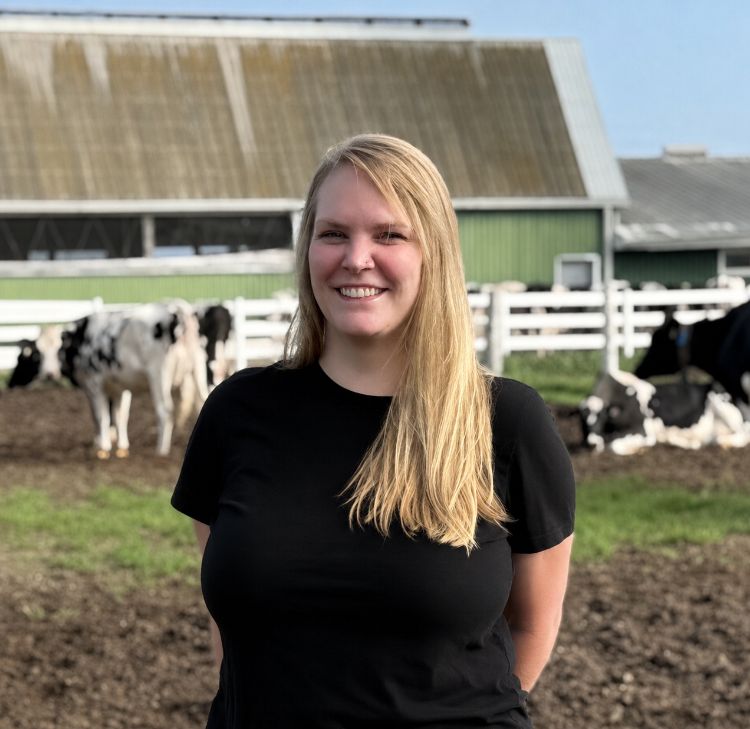
Tracy Burnett will serve as an MSU Extension dairy educator in Michigan’s Thumb region.
MSU Extension dairy educators host the Virtual Coffee Break podcast and interview dairy farmers, MSU faculty members and agribusiness professionals about all aspects of dairy farming. MSU Extension dairy educator Martin Mangual interviewed his new colleague Tracy Burnett as she begins her new role as an MSU Extension dairy educator.
Prefer to listen instead? You can find the podcast on Apple Podcasts or Spotify.
Martin: Tracy Burnett has recently joined our MSU Extension Dairy Team as a dairy educator. We will discuss her background, expertise and ways she looks forward to serving Michigan's dairy industry. For those who have not met you yet, tell us a little bit about yourself.
Tracy: I grew up in British Columbia, Canada, in a small seaside town called White Rock on the border with Washington State. I didn’t get involved in agriculture until I began working on my master’s degree at the University of British Columbia. My research focused on assessing chronic stress in dairy cattle, and I did this by looking at their hair.
On crime shows like CSI, you see researchers analyzing hair to detect toxin or drug exposure. It turns out, you can also analyze cortisol levels in hair from cows to understand stress. I looked at chronic stress as it relates to production and reproductive outcomes and continued this work during my PhD.
In my PhD, I also studied the use of activity monitors and how we can measure the intensity of estrous expression and strategically incorporate activity monitors for this purpose. For example, can we use them to cherry-pick heats during an Ovysynch protocol? Can activity monitors be part of a strategy to increase the fertility of cows with low estrous expression?
After I completed my PhD, I worked for six years at the University of Guelph before coming to MSU. My specialty is in reproduction and precision technology, but I’m well-versed in other areas as well and happy to help wherever I’m needed.
Martin: You mentioned that you didn’t have experience in agriculture before you began your master’s program. What brought you to agriculture?
Tracy: When I went to university, I knew I wanted to work with animals, and I thought the only career with animals was veterinary science. But I very quickly found out that, actually, I'm not suited to do this. So, I was looking for other avenues for how to work with animals and at the University of British Columbia, they have a dairy farm that is commercially run but is also used for research. They were looking for a summer student to work there, and I applied and was hired. I cleaned, fed calves, did odd jobs, vaccinated cattle, and did field work. And from that introduction, I just really was drawn to all the complexity of dairy farming. I really like biology and physiology, and dairy cows are amazing animals, so that's what really drew me in, and I just kept going! I lived on that farm for about 10 years straight. So yeah, I kind of got the bug.
Martin: Well, I’m glad you did, and I’m glad that’s part of what set you on the path to working at MSU. Some people may not be aware that all our educators can help around the entire state of Michigan, but are based at specific locations around the state. Where can people find you?
Tracy: My area is Michigan’s “Thumb” region, and I have offices in Lapeer County and Huron County.
Martin: So before coming to Michigan, you mentioned you spent some time at the University of Guelph. Can you tell us a little bit about your role in the University of Guelph?
Tracy: At the University of Guelph, I was a College Research Professor. Essentially, this was an applied teaching and research position. My teaching role was with two-year diploma students, and so somewhere between 70-85% of the students each year were either dairy farmers themselves, or they had worked on a farm. This was really nice.
When I was teaching, I always started with the why. So we really spoke about why we do these practices. What are the best practices? What is backed by science? Those types of things. And then we moved into the how, which was showing them how to perform the best practices. So how do we dehorn a calf? How do we hoof trim a cow? All those things.
Martin: This program sounds very similar to the MSU Ag Tech program where students can earn a certificate in dairy management. Something that is great about Extension is that we provide a link between understanding recent scientific learning and applying it at the farm level. So I think this background is valuable for our team, especially considering that dairy farm workforce development is a big portion of our educational programming.
So as you get started, what does your role look like? What can dairy producers expect to see you working on?
Tracy: My focus right now is really building relationships within the community. And I really want to understand what the needs are. My ultimate goal is to build programming around the needs of the producers in the area. And this is where I need the help of dairy producers in the Thumb: please contact me and let me know what you would like to see from Extension programs! This is a great time to share your opinions and shape the dairy programs offered.
Martin: Which parts of dairy are you particularly interested in or excited about working on?
Tracy: My true passion is reproductive management. Of course, that's what I'm trained in. But this is actually broader than maybe most people think. This can include anything from using activity monitors or incorporating different aids to help assist heat detection, for example. It could be about how do we increase our compliance on reproductive protocols. Something I'm really interested in is benchmarking reproductive indices and seeing what different people are doing and how they're being successful. It could even just be understanding the reproductive physiology so that you can understand why you're doing the shots you're doing at breeding.
I do have other experiences as well. I've worked quite a bit with transition cow health. I've also worked with cow comfort, heat stress and different stressful events as well. So, I am interested in other things. But reproduction is really my number one.
Martin: So when should a dairy producer call you? Walk me through a potential situation that they should reach you out and then that you are able to come in and give a helping hand.
Tracy: If a farmer is starting a new project and they're just looking for resources, then that's a perfect time to contact me. Or it could be something more complex, that they're having an issue, they want to interpret data, or they're having a troubleshooting issue. Something that I would really love to get started is troubleshooting the use of technology. For example, let's say you have an automated technology, but you're either having problems or issues incorporating that into your normal management, or maybe you're using it, but you don't think that it's as successful as it should be or that you wanted it to be, then I think that would be a really great time to reach out. I would love to help producers troubleshoot through that so that we can maximize the efficiency of the technologies we have. I tell producers, if you're using precision technology, reach out anyway, even if you think that is working, because one thing that I have seen when farmers implement technology is that sometimes you might not be getting all you can get out of it.
Martin: And I think sometimes with all the new technology, that's sometimes what happens. You buy a technology because the salesperson tells you A, but it can also do B, C and D. So even if you have a new technology and it's working, reach out to Tracy and maybe there's a little bit more to get out of that technology that you already have on the farm working for you.
Tracy: Absolutely, we are here for whatever farmers need. Even if you don’t know if we can help, reach out. The best way to get ahold of me is by email: burne200@msu.edu.