Managing calf comfort in cold weather
 Print
 Email
What are the best practices for calf jackets?
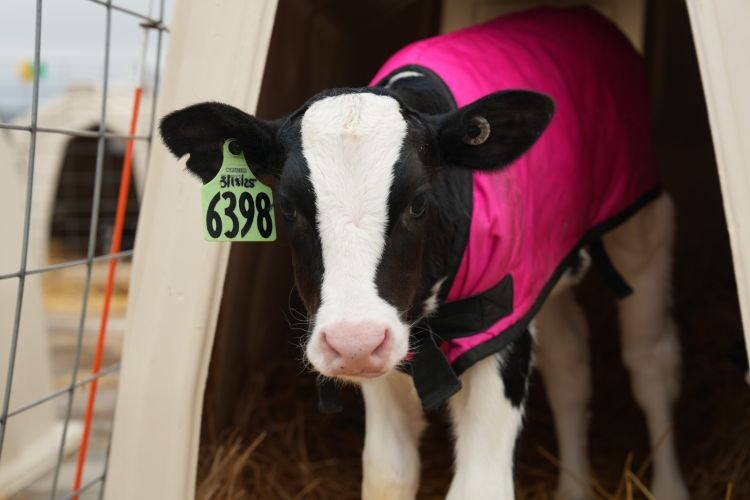
Cold stress affects welfare and takes energy away from growth and immunity in young calves. What do we know about good management practices for calf jackets?
You may think that calves in nature never had a jacket, and that is partly true. The wild cattle ancestors of today's dairy breeds, especially those that evolved in cooler climates, had a jacket of their own: a thicker hair coat than today's dairy calves. Even so, wild calves faced health and welfare challenges that we should not accept today. We want calves to grow well with as few stressors as possible, because good health and growth early in life support future milk production and farm efficiency.
Young calves have a hard time keeping their body temperature steady in their first weeks of life for four main reasons:
- Size: they are small, so they have a lot of skin for their size
- Skin: their skin is thin and they have little body fat to keep them warm
- Circulation: they cannot reduce blood flow to the skin as well as adult cows to hold in heat
- Rumen: their rumen is not yet working, so it cannot produce heat the way an adult cow's rumen does.
These early weeks of life are when calves also build their own immune defenses, and cold stress can disrupt this process, making calves more likely to get sick.
For Michiganders, a jacket on a young calf may be a good option, especially for calves housed individually, although no study has yet tested calf jackets in Michigan weather conditions. Over the last five winters, monthly average daily temperatures in Michigan ranged from 6.8 degrees Fahrenheit to 41.5 F from December to February, and cold waves brought temperatures as low as -19 F, as recorded in Grand Rapids in January 2026.
Disbudding in winter may affect calf temperature
One more point for cold months: disbudding causes inflammatory pain that can affect calves' ability to maintain body temperature. Good pain control (local anesthesia plus a non-steroidal anti-inflammatory drug) is even more important when disbudding happens in cold weather. With national and international collaborators, the Trindade lab is studying how disbudding pain affects the way calves cope with cold and welfare-health-production outcomes.
Good management practices
Keep jackets clean
A jacket soiled with feces holds moisture against the skin and can spread pathogens. Check jackets, especially when a calf has diarrhea, and change or wash soiled jackets right away.
Keep calves dry
Put a jacket on only after the newborn calf is completely dry. Run a hand under the jacket daily and, if the hair feels damp, remove the jacket until the calf is dry.
Take extra care in transition months
From fall to winter and winter to spring, temperatures can change a lot within the same day. A jacket that is right on a cold morning can be too warm at the afternoon peak, and the calf may sweat. If its hair is still wet when temperatures drop in the evening, the calf has a much harder time keeping warm.
Wash jackets between calves
Jackets can carry manure and pathogens from one calf to the next, so wash and fully dry them before reuse.
Questions or suggestions? Email me at trindad4@msu.edu! I would love to hear about your experiences with calf jackets and your ideas for new research that meets the needs of dairy producers.