


Introduction
-
Basic concepts
-
Difference and relationship between telecoupling and metacoupling
-
Three types of coupling: intracoupling, pericoupling, and telecoupling
-
The five main components of the telecoupling framework
-
System roles: sending, receiving and spillover
-
Common misconceptions
-
Why these frameworks matter for sustainability
-
Frequently asked questions
Basic concepts
What is telecoupling?
Telecoupling refers to socioeconomic and environmental interactions (or human-nature interactions) over distances. It is an umbrella concept that expands and integrates concepts of distant interactions in various disciplines. For example, animal migration has been extensively studied from an ecological perspective, yet it has enormous socioeconomic implications. When both ecological and socioeconomic dimensions are considered, animal migration can be viewed as a telecoupling. On the other hand, human migration has been extensively studied from socioeconomic perspectives, but it has profound environmental implications. When both socioeconomic and environmental dimensions are considered, human migration can also be viewed as a telecoupling. Other types of telecoupling include trade, foreign investment, water transfer, technology transfer, and species invasion.
What is metacoupling?
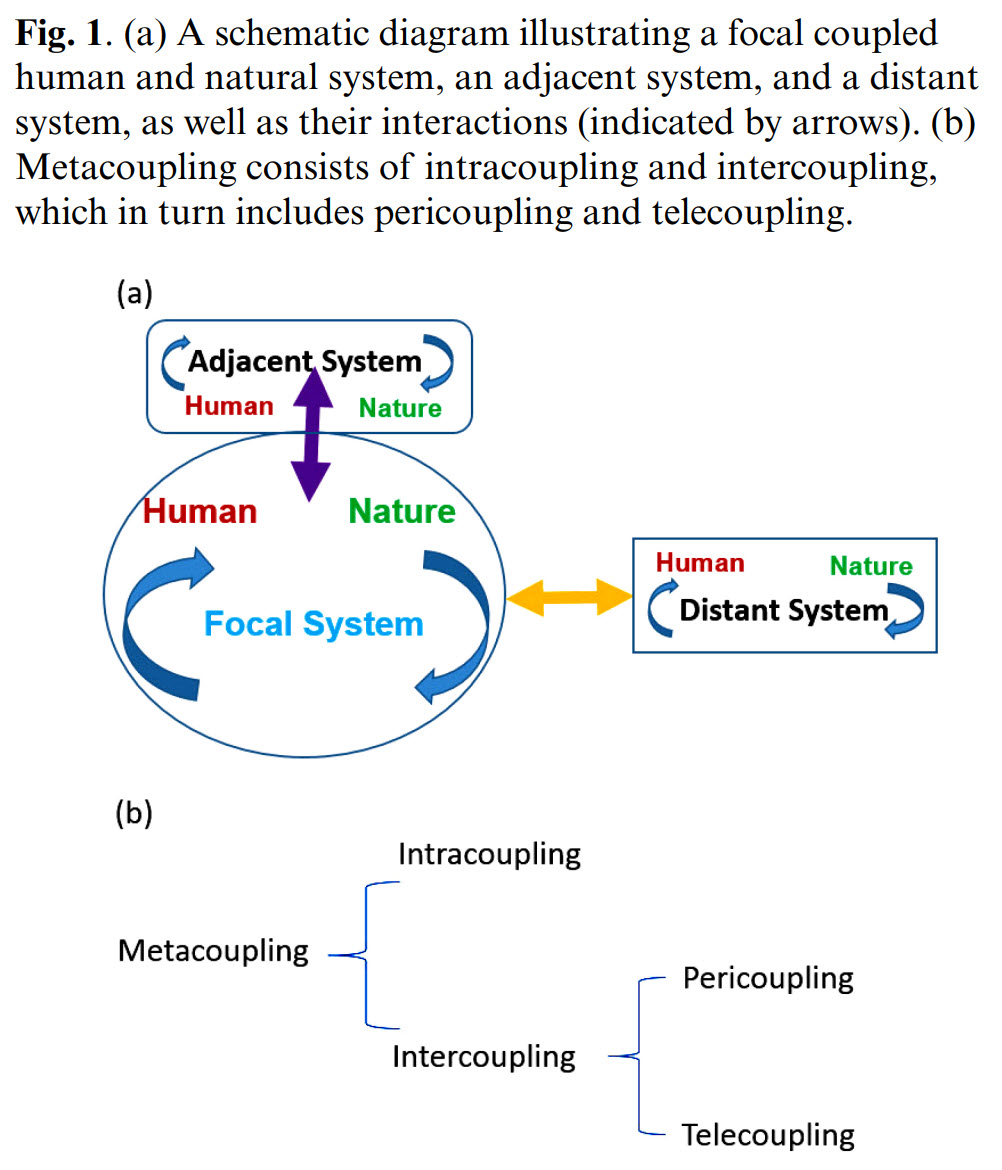
Metacoupling refers to human–nature interactions within a system (intracoupling), between adjacent systems (pericoupling), and between distant systems (telecoupling). It is broader than telecoupling. It encompasses interactions across multiple scales – from local to global.
What is the telecoupling framework?
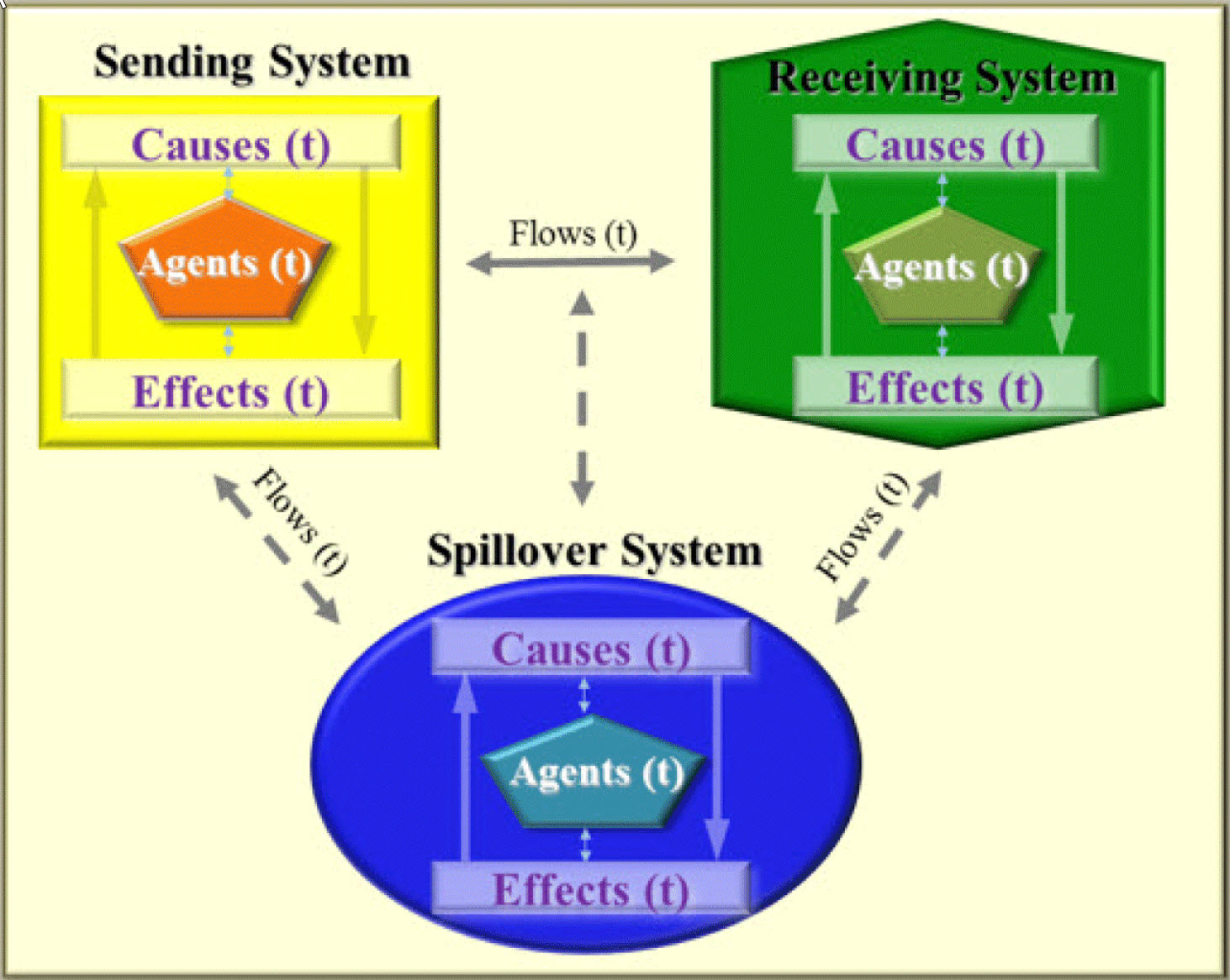
The telecoupling framework is a structured analytical architecture for studying telecoupling systematically through interrelated components -- systems, flows, agents, causes, and effects. Flows are movements of people, information, energy, matter, organisms, goods, etc. Systems are coupled human and natural systems, such as cities and countries. Depending on the flow directions, systems can be sending, receiving, or spillover systems. Agents are decision-making entities, such as policymakers and traders, that facilitate the flows. Causes are reasons behind the flows. Effects are consequences of the flows. The framework provides a consistent, comprehensive yet flexible way to examine how distant interactions emerge, what shape them, and what consequences they produce.
What is the metacoupling framework?
The metacoupling framework is the integrated analytical architecture that brings intracoupling, pericoupling, and telecoupling together and examines their interrelationships and impacts. It consists of the telecoupling framework, pericoupling framework (which is similar to the telecoupling framework except that the sending and receiving systems are nearby rather than far away), and intracoupling framework (which focuses on human-nature interactions within a system).
How to distinguish concepts from frameworks
A simple rule of thumb is this: the concepts describe phenomena, while the frameworks are architectures to help analyze phenomena. Telecoupling and metacoupling refer to differenttypes of human-nature interactions .
The telecoupling framework and metacoupling framework are the structured ways of analyzing those different types of human-nature interactions.
Difference and relationship between telecoupling and metacoupling
Telecoupling refers to distant human-nature interactions. Metacoupling includes internal, adjacent, and distant human-nature interactions together.
The relationship is nested. Telecoupling is one part of metacoupling.
Three types of coupling: intracoupling, pericoupling, and telecoupling
Metacoupling includes three spatial types of human–nature interactions: intracoupling, pericoupling, and telecoupling.
- Intracoupling refers to human–nature interactions within one coupled system. Examples include activities such as farming, fishing, and timber harvesting within a place.
- Pericoupling refers to human-nature interactions between adjacent systems. Examples include trade, migration, species invasion, technology transfer, knowledge transfer, and tourism between neighboring places.
- Telecoupling refers to human-nature interactions between distant systems. Examples include trade, migration, species invasion, technology transfer, knowledge transfer, and tourism between distant places.
The five main components of the telecoupling framework
The telecoupling framework is organized around five interrelated components: systems, flows, agents, causes, and effects. Together, these components help researchers ask what systems are connected, what flows link them, what shapes those flows, why they occur, and what consequences they produce.
Systems: the coupled human and natural systems that are connected in the analysis. Depending on the study, a system can be a country, province, city, county, village, watershed, or another context-defined unit.
Flows: the movements of people, organisms, goods, matter or materials, energy, capital, and information. Flows can be unidirectional or bidirectional, and they can move directly between systems or indirectly through spillover systems.
Agents: the decision-making entities or actors that facilitate or hinder flows. They can include individuals, households, firms, governments, traders, and, in some cases, nonhuman actors such as animals.
Causes: the drivers behind the emergence and dynamics of flows. These may be political, economic, cultural, technological, ecological, or other factors, and a telecoupling often has more than one cause.
Effects: the socioeconomic and environmental consequences produced in one or more systems. These may include trade-offs, synergies, feedbacks, time lags, nonlinearities, legacy effects, and cascading effects.
Fig 2. The telecoupling framework links sending, receiving, and spillover systems through flows, with agents, causes, and effects inside each system.
System roles: sending, receiving and spillover
Sending system: the system from which the focal flow originates.
Receiving system: the system that obtains the focal flow.
Spillover system: a system that affects and/or is affected by the interaction between sending and receiving systems. Spillover systems can be connected by being an intermediate stopover, a pathway between systems, or a third-party system interacting with the sending and/or receiving systems.
Two points help prevent confusion. First, the same place can be a sending system for one flow and a receiving or spillover system for another, because these roles depend on the direction of the focal flow being analyzed. Second, sending systems are not automatically active and receiving systems are not automatically passive; the power dynamics depend on the case.
Common misconceptions
Myth vs Fact:
Myth: Telecoupling is just another word for globalization or trade.
Fact: The concept of telecoupling builds on, expands from, and integrates concepts such as teleconnection (distant climatic interactions) and globalization (distant socioeconomic interactions), but it is more comprehensive because it explicitly links socioeconomic and environmental interactions, feedbacks, and multiple system roles.
Myth: Telecoupling and telecoupling framework mean the same thing.
Fact: Telecoupling is the interaction type or phenomenon; the telecoupling framework is the structured way of analyzing it.
Myth: Telecoupling only applies between countries.
Fact: Telecoupling can occur within a country or region as long as systems are linked over distance. Distance is a relative concept, depending on the research questions and specific issues addressed.
Myth: Metacoupling replaces telecoupling.
Fact: Telecoupling is nested within metacoupling. Metacoupling is the larger umbrella that includes intracoupling, pericoupling, and telecoupling together.
Myth: Sending systems are always active and receiving systems are passive.
Fact: Not necessarily. Sending and receiving systems can be active or passive depending on the flow and the case-specific power dynamics.
Myth: Spillover systems are secondary and can usually be ignored.
Fact: Spillover systems can be central to explanation and governance, and important consequences may occur outside the main sending–receiving pair.
Myth: A proper telecoupling paper must study all five components equally.
Fact: The framework is comprehensive but flexible. A paper can focus mainly on one component , as long as it remains clear about the broader telecoupled context.
Myth: System boundaries must be fixed in advance.
Fact: System boundaries are context-dependent and often refined during the research process rather than finalized in advance.
Myth: The telecoupling and metacoupling frameworks are only for environmental science.
Fact: From the start, these frameworks were designed to inherently integrate socioeconomic and environmental dimensions, and applications now span agriculture, economics, demography, trade, migration, biodiversity, tourism, water, energy, species invasion, technology transfer, governance, and numerous other fields. As of 2024, papers on the applications of these frameworks had been published in more than 130 different international journals across various disciplines.
Myth: Using the frameworks means filling in a checklist.
Fact: The value of the frameworks lies in their systematic and comprehensive yet flexible approaches to understanding relationships, feedbacks, and dynamics among components, not simply naming the components one by one.
Why these frameworks matter for sustainability
Many sustainability problems no longer stay in one place. Food demand, tourism, migration, species invasion, water transfer, trade, finance, and information flows increasingly connect distant and adjacent places worldwide.
Telecoupling and metacoupling frameworks help researchers and decision-makers address hidden feedbacks, spillovers, trade-offs, and synergies across space. They are especially useful because they integrate socioeconomic and environmental consequences together and make it clear how benefits in one place may create costs elsewhere.
Frequently asked questions
1. Why not use “telecoupling” and “telecoupling framework” interchangeably?
Because they refer to different things. Telecoupling is the concept of distant interactions, while the telecoupling framework is the analytical structure used to study those interactions.
2. Why not use “metacoupling” and “metacoupling framework” interchangeably?
For the same reason. Metacoupling names the combined set of within-system, nearby, and distant interactions, while the metacoupling framework is the integrated structure used to analyze those interactions together.
3. Does telecoupling only mean international trade?
No. Trade is only one example. Telecoupling can involve migration, species invasion, tourism, knowledge transfer, technology transfer, water transfer, foreign investment, and other distant interactions.
4. Does the metacoupling framework use the same five components?
The telecoupling and pericoupling frameworks use the five interrelated components—systems, flows, agents, causes, and effects—and the metacoupling framework brings those component frameworks together while also accounting for intracoupling, pericoupling, telecoupling and their interrelationships.
5. What counts as a system?
A system is a coupled human and natural system. Depending on the research design, it could be a country, province, city, county, village, watershed, or another relevant unit.
6. What counts as a flow?
A flow is the movement of people, organisms, materials, energy, capital, or information between systems. Flows can be direct or indirect, and one-way or two-way.
7. Can one place be both a sending and receiving system?
Yes. The same place can be a sender for one flow and a receiver or spillover system for another, because the labels depend on the flow being analyzed.
8. What is a spillover system?
A spillover system is a system that affects and/or is affected by the interaction between sending and receiving systems. It may be a stopover, a pathway, or another connected system outside the main sender–receiver pair.
9. Do I need to use all five components in every study?
No. The framework is designed to be systematic, but it is also flexible. A single paper can focus on one component more deeply while still using the broader framework to stay conceptually clear.
10. Does telecoupling ignore local interactions?
Telecoupling itself focuses on distant interactions. When local and nearby interactions also matter, the broader metacoupling framework is more appropriate because it integrates all three spatial types together.
11. Can these frameworks be used with qualitative or mixed methods?
Yes. They are conceptually flexible and can be used with qualitative, quantitative, spatial, and mixed-method approaches.
12. Why does this matter for sustainability?
Because many sustainability problems involve hidden connections across space. These concepts and frameworks help reveal how actions in one place can create benefits, costs, feedbacks, and trade-offs elsewhere.
13. Why are spillover systems important?
Because important effects often occur outside the main sending–receiving pair, and identifying those hidden spillovers is central to understanding telecoupled dynamics and sustainability outcomes.
14. Are these frameworks only for environmental science?
No. They are designed to integrate both social and environmental dimensions and are useful across many fields.
 Print
Print Email
Email