


Intelligent Robots and Sensors for Real-time Monitoring

Intelligent Robots and Sensors for Real-time Monitoring
Vision:
Vast volume and spatiotemporal variability pose significant challenges in monitoring water resources and agricultural infrastructure (e.g., drainage networks). Sensing solutions enabled by innovative robots and machine learning have significant promise in addressing these challenges. Targeting the pain points in current practices, we aim to develop novel robotic systems and sensors for real-time monitoring, such as water quality sampling, invasive species detection, and fish movement tracking
Representative Projects:
-
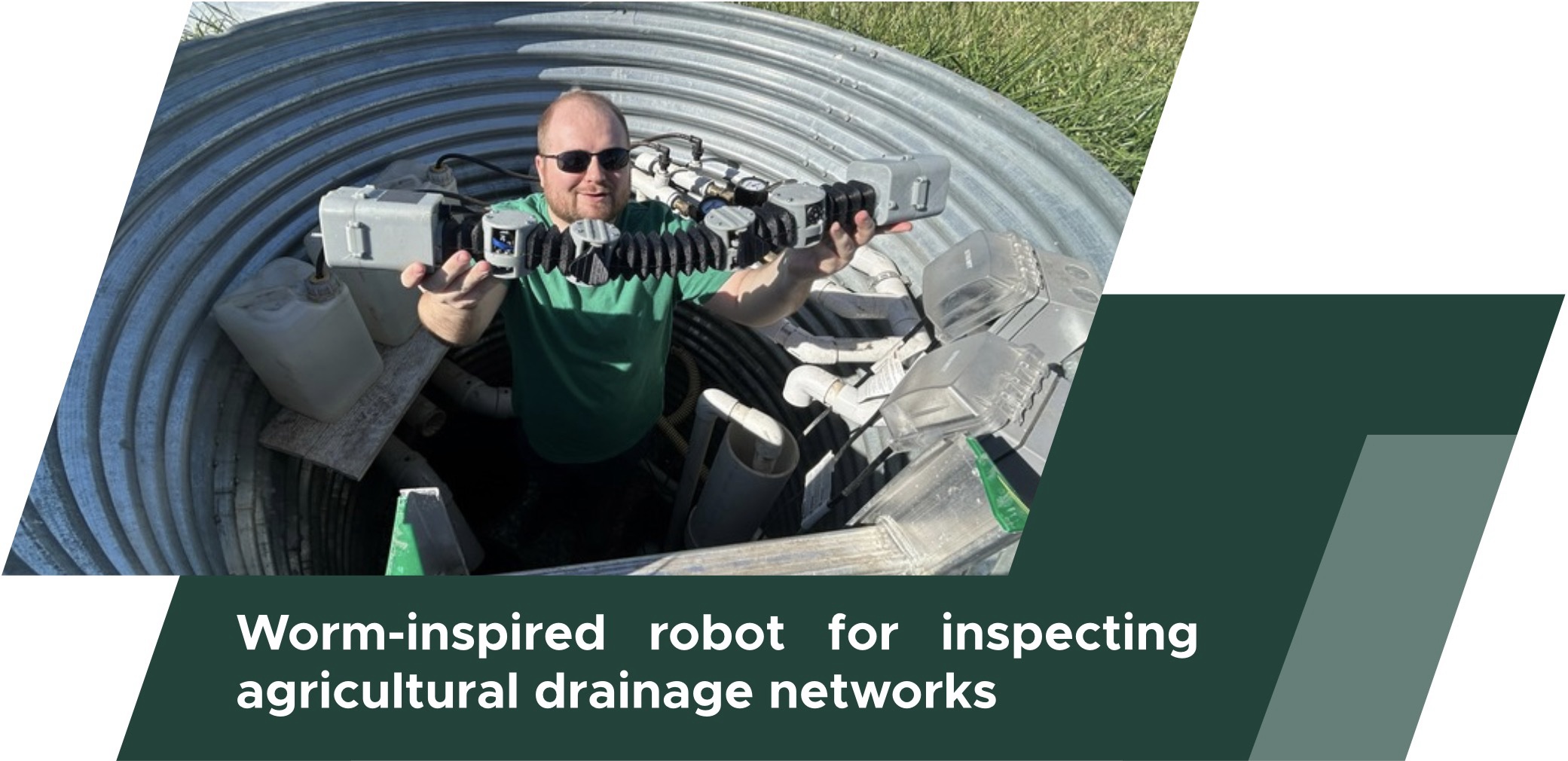
Worm-inspired robot for inspecting agricultural drainage networks. Agricultural subsurface drainage systems play an essential role in improving farm operations and crop yields, but it is difficult and costly to inspect and diagnose drainage pipes as they are buried deep underground. Exploiting the structural features of corrugated pipes, we are advancing worm-inspired robot for in-situ inspection and mapping of drainage systems.
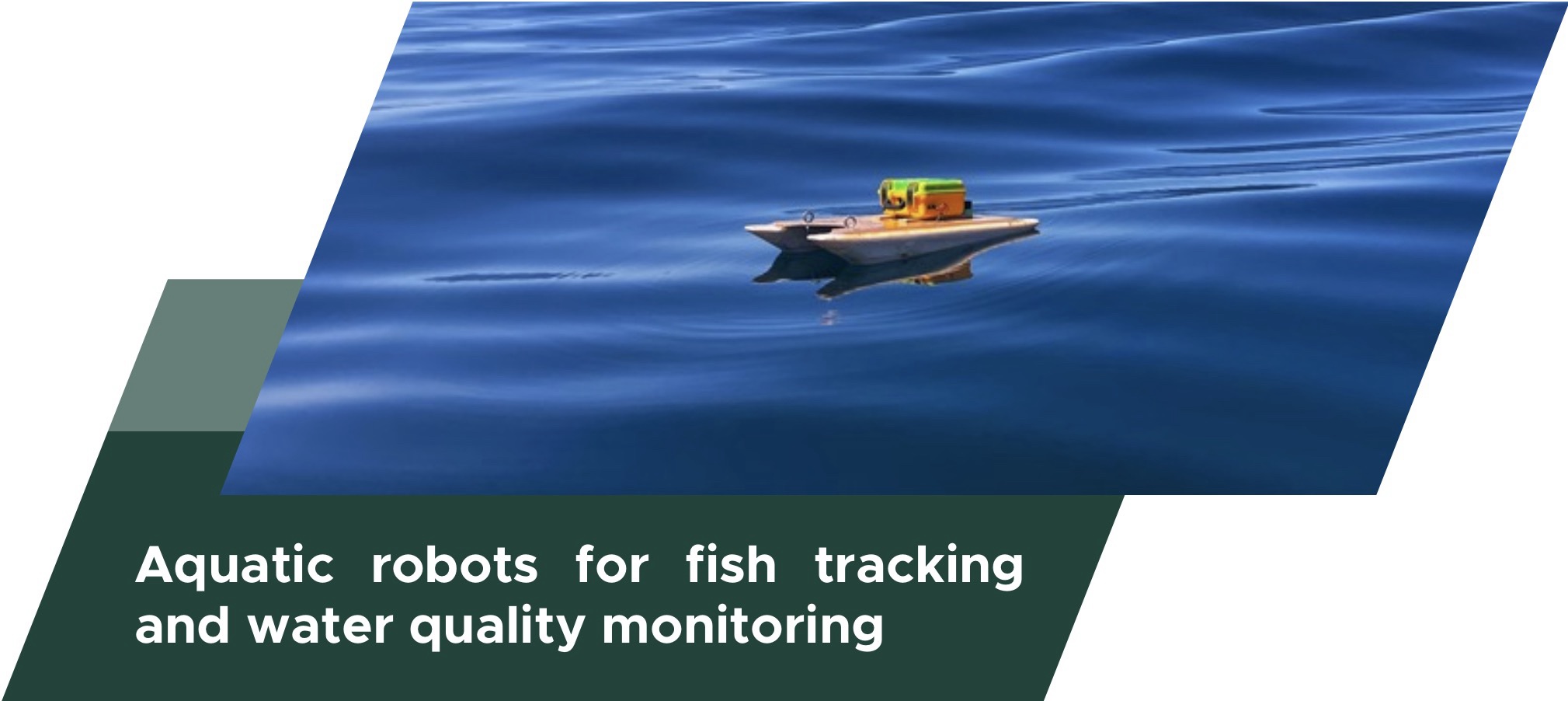
- Aquatic robots for fish tracking and water quality monitoring. We design and build autonomous underwater and surface robots (such as gliding robotic fish, active drifter, and uncrewed surface vehicle) for mobile sensing of aquatic environments, ranging from monitoring of harmful algal blooms and other water parameters to tracking of fish movement using acoustic telemetry. We are also interested in developing adaptive sampling algorithms to improve efficiency of mobile sensing.
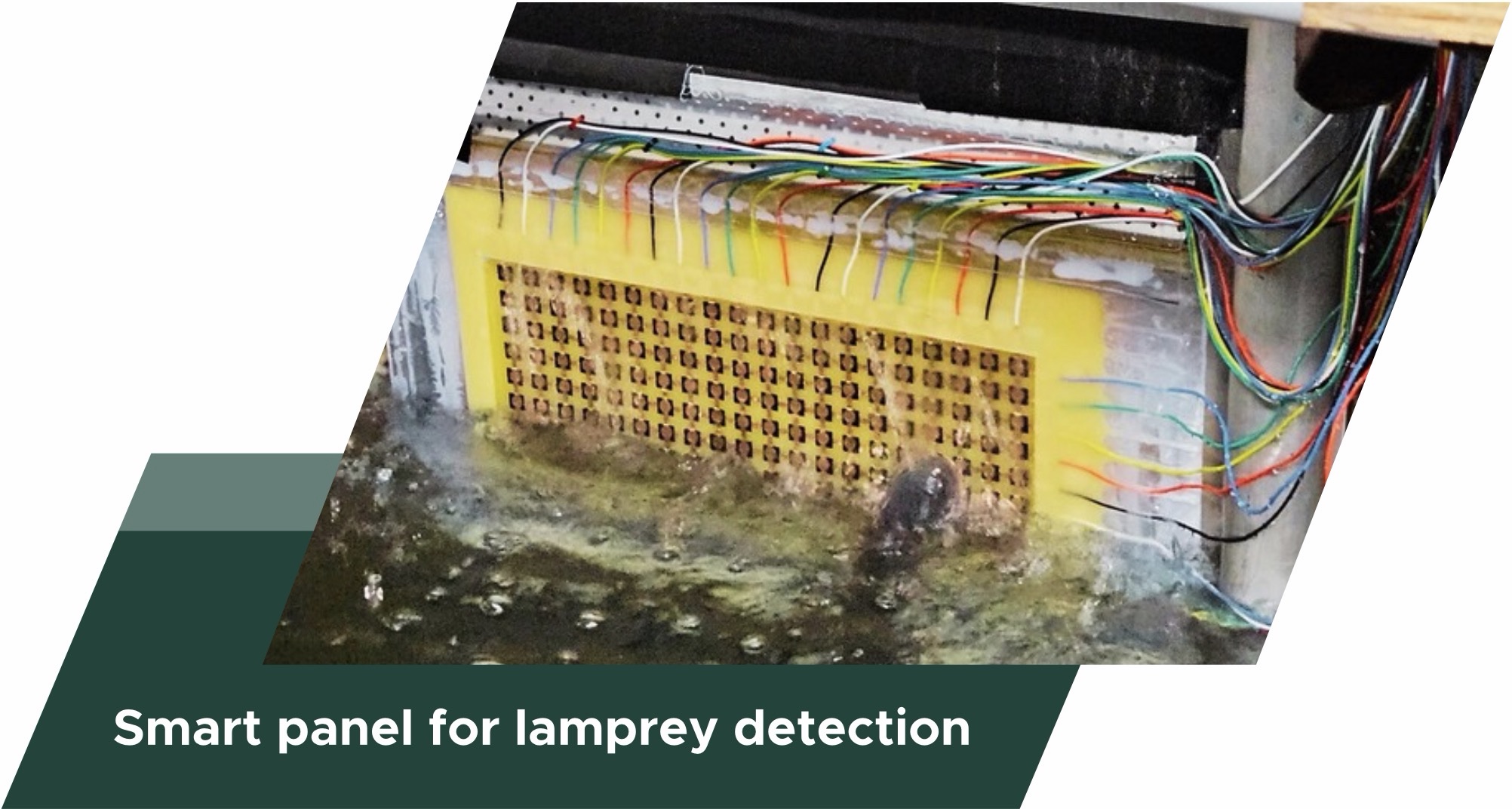
- Smart panel for lamprey detection. Sea lamprey is a notorious invasive species in the Great Lakes and poses a serious threat to the fishery sector and the ecosystem sustainability in the region. Being able to detect or track sea lamprey is of significant importance to population assessment and control of this species. Exploiting the lamprey’s suctorial attachment behavior, we develop smart pressure/contact-sensing panels that detect the lamprey attachment, which could subsequently trigger a control action. The same technology is being explored for population assessment and conservation of Pacific lamprey, a native species in the Pacific Northwest.
Team Leadership
Team Lead:
Dr. Xiaobo Tan

Dr. Xiaobo Tan is an MSU Research Foundation Distinguished Professor and the Richard M. Hong Endowed Chair in Electrical and Computer Engineering at Michigan State University (MSU). He received his bachelor's and master's degrees in automatic control from Tsinghua University, Beijing, China, and his Ph.D. in electrical and computer engineering from the University of Maryland, College Park. His research interests span underwater robotics, soft robotics, smart materials, and control systems. In particular, his group has developed a number of robots and sensors for various agricultural, industrial, fishery, and environmental applications. He has published over 300 papers and been awarded 8 US patents in these areas.
Contact:
428 S. Shaw Lane, Rm. 2120, East Lansing, MI 48824
Select Publications:
C. Luedtke, X. Zhou, and X. Tan, “A 3D-printed worm-like robot for corrugated pipes using anisotropic fins,” IEEE/ASME Transactions on Mechatronics, vol. 30, no. 4, pp. 3046-3053, 2025. https://ieeexplore.ieee.org/document/11018750
I. Gonzalez-Afanador, C. Chen, G. Morales, S. Miehls, H. Shi, X. Tan, and N. Sepulveda, “Real-time invasive sea lamprey detection using machine learning classifier models on embedded systems,” Neural Computing and Applications, vol. 36, pp. 16195-16212, 2024. https://link.springer.com/article/10.1007/s00521-024-09897-3
H. Shi, Y. Mei, I. Gonzalez-Afanador, C. Chen, S. Miehls, C. Holbrook, N. Sepulveda, and X. Tan, “Automated soft pressure sensor array-based sea lamprey detection using machine learning,” IEEE Sensors Journal, vol. 23, no. 7, pp. 7546-7557, 2023. https://ieeexplore.ieee.org/document/10058136
E. M. Gaskell, T. R. Funnell, C. M. Holbrook, D. W. Hondorp, and X. Tan, “Characterization of acoustic detection efficiency using an unmanned surface vessel as a mobile receiver platform,”
Animal Biotelemetry, vol. 11, Article 41 (13 pp), 2023. https://link.springer.com/article/10.1186/s40317-023-00350-1
F. Zhang, O. Ennasr, E. Litchman, and X. Tan, “Autonomous sampling of water columns using gliding robotic fish: Algorithms and harmful-algae-sampling experiments,” IEEE Systems Journal, vol. 10, no. 3, pp. 1271-1281, 2016. https://ieeexplore.ieee.org/document/7182734
 Print
Print Email
Email