Learning Session Summary: The Mississippi Story of Relationships, Culture, and Planning Food Futures
November 16, 2026 - Noel Didla, Liz Broussard Red, Colleen Matts and Lindsey Scalera
 Print
 Email
The Statewide and Regional Food Systems Plans National Community of Practice hosted a Learning Session on October 27, 2026 with guests Noel Didla and Liz Broussard Red who shared a story of relationships, culture, and planning food futures for Mississippi.
Session Details
Guest speakers:
- Noel Didla and Liz Broussard Red, Co-Stewards, The Center for Mississippi Food Systems
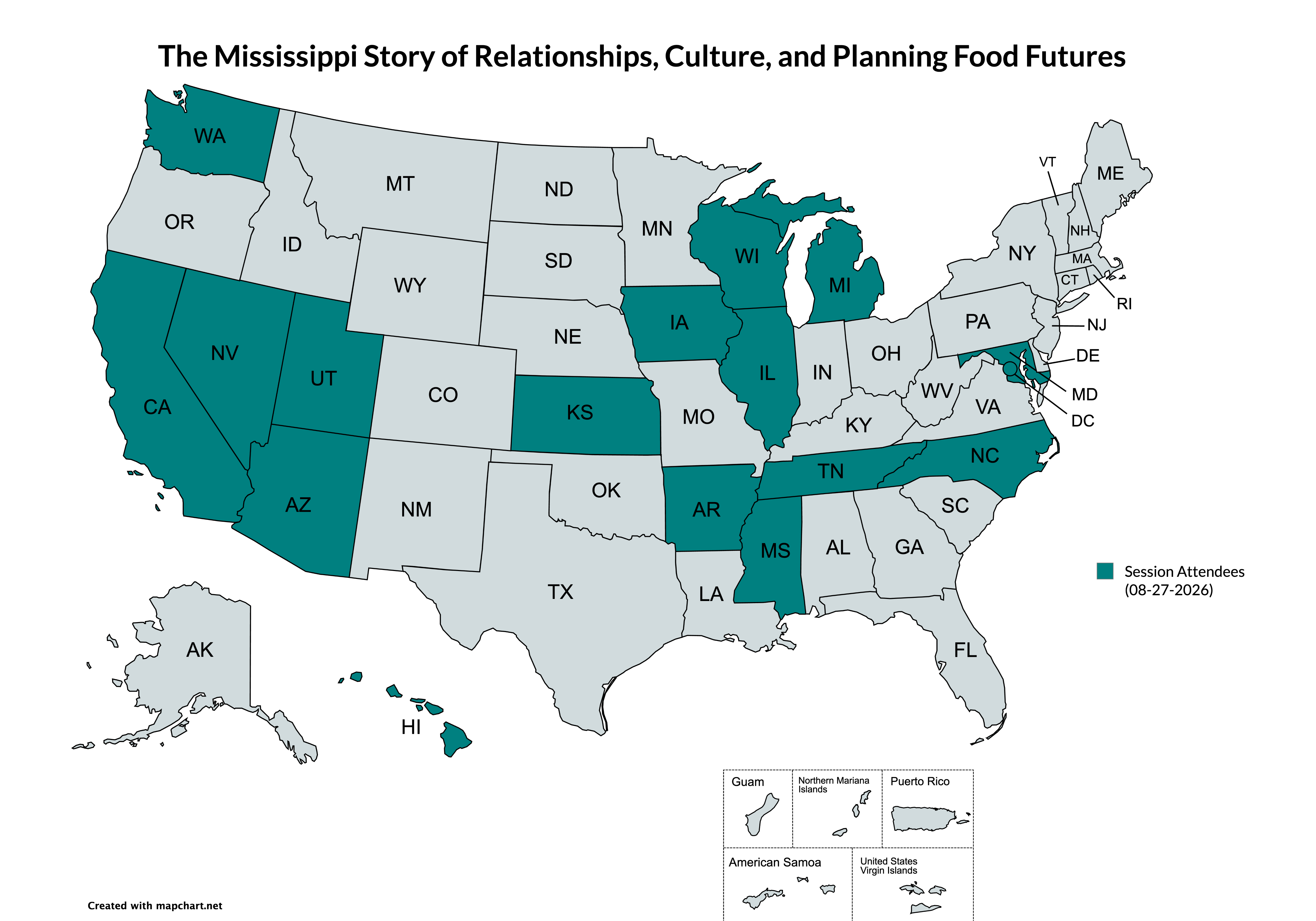
Attendees joined from two countries: Australia and the U.S. From within the U.S., meeting participants represented Washington, D.C. and 16 states: Arizona, Arkansas, California, Hawaii, Illinois, Iowa, Kansas, Maryland, Michigan, Mississippi, Nevada, North Carolina, Tennessee, Utah, Washington, and Wisconsin.
Welcome
The Statewide and Regional Food Systems Plans National Community of Practice (NCoP) brings together leaders from across the U.S. around current and emerging food system plan efforts to share knowledge and strengthen local and regional food systems. Check the NCoP website for upcoming scheduled sessions as well as summaries and recordings (when possible) to follow each session.
Grounding Poll
We asked the participants to share the status of their food system plans (if applicable).
- Approximately 27% of participants have a plan in development or an update to their existing food system plan in progress.
- About 18% have an active food system plan for their region.
- Just under 10% of participants do not have a food system plan or any known plans in place to develop one.
- And the majority of participants, about 46%, do not have a plan yet in place, but recognize interest in developing one.
Land & Peoples Acknowledgements
For Michigan hosts
Michigan State University occupies the ancestral, traditional, and contemporary Lands of the Anishinaabeg – Three Fires Confederacy of Ojibwe, Odawa, and Bodéwadmi peoples. The University’s campus resides on the traditional Lands of the Saginaw Band of Chippewa, ceded under coercive or violent circumstances in the 1819 Treaty of Saginaw. Michigan State University is supported through the Land Grant Act, where 10.7 million acres were taken from 245 Tribal nations through the treaty system to fund and establish agricultural colleges. Michigan State University was established on and with 235,193 acres of Anishinaabe Land ceded in the 1819 Treaty of Saginaw and the 1836 Treaty of Washington.
Michigan State University recognizes, supports, and advocates for the sovereignty of Anishinaabe Nations from the Great Lakes area, for historic Indigenous communities in Michigan, for Indigenous individuals and communities who live here now, and for those who were forcibly removed from their homelands. By offering this Land Acknowledgement, we affirm Indigenous sovereignty and will work to hold ourselves more accountable to the needs of Indigenous peoples and to the creation of equitable and fair policies for years to come.
For Mississippi guest speakers
Choctaw
We acknowledge those that were brave enough to stay behind, paid the ultimate sacrifice through racism and adversity, and survived as Mississippi Choctaws. Our ancestors paved the way to our sovereignty and self-determination. Tribal leaders, before their time, may not have known it, fought for our education, culture, and way of life.
Delta
We acknowledge the richness of the soil and the land in the Delta that was the ancestral home of Indigenous people and was tilled and worked by enslaved African people. We make a commitment to restoring and regenerating the soil making it more prosperous and accessible for ourselves and the generations that follow.
Jackson
We as Indigenous, African Americans, Latinx, Women are Mississippians. We acknowledge the truth and legacies of white supremacy through policy that has impacted our food systems. We acknowledge inhumane policies such as the separation of families, mass incarceration, border policies, and public health.
Coast
We acknowledge the earliest people on this land who came before recorded history, the Choctaw, Chickasaw, and the Creek for the settling of this land and upholding the sacredness of this ecosystem. The enslaved Africans for leaving a legacy of a self-sustaining people. We are grateful for the love shared and generational gifts of culture and light by the mixing of tribes and bloodlines in the name of peace.
Introduction and Visioning Activity
Guest speakers for this session, Noel Didla and Liz Broussard Red, along with their colleague Alex Lawson, are Co-Stewards for The Center for Mississippi Food Systems (CMFS). They share a lifelong purpose to work on food systems transformation and regional economic transformation, as they are led by their people and the truths and legacies of their places. They expressed gratitude for the gift to be in this space with those who are also working on food systems solutions across the country. In this session, they first shared their story, including where they are in their arc of transformation, before engaging with and learning from attendees about why food plans matter.
In an effort to help everyone be present, open, and connected for the session, Noel led the group through breathwork with this guidance: “Nothing to control. Nothing to force. Just feel the air coming in, the air going out. Rise. Fall. Stay with it. When the mind wanders, gently return, again, and again, and again. In this simple breath, the present moment is alive - for you, for me, for us.”
A question was then posed for the group of attendees to consider and journal quietly to themselves, for their geography or place:
“As our communities experience so much upheaval due to bad policy, what is one ideal way your local leaders and policymakers deserve to show up in your food solutions work?”
Responses or reflections were invited through the chatbox, or sharing when the group returned together. For the CMFS team, and after several years of doing this work and being “in purpose,” they would like local leaders and policymakers to show up by being present in communities where this food solution work is happening, so that they are co-creators of policy and working alongside them in crafting community and a vision. Noel also later noted that as one of the poorest states in the country, people in Mississippi have learned and stepped into the practice of starting from a place of dignity, determining what they deserve, in how they see themselves and how others see them.
- One attendee from Hawaii expressed interest in and supported efforts related to soil health bills at the state level. Since they have not been well received in previous years, they will try to have youth speak to these needed bills as a new approach.
- Another attendee supported the idea that any presence of policymakers in community spaces would be a start, and a win toward food being a priority, including its integration with other priorities such as housing.
- A planner in attendance suggested their city council members and county mayors host and attend more coffee hours, including to discuss ways to actively seek out feedback and community members’ experiences with food security. This attendee wishes for leaders to proactively solve other socioeconomic issues through food.
Stories of Relationship
Liz Broussard Red’s Story
Liz Broussard Red began sharing her story by thanking those who stewarded her arrival in Mississippi. She moved to MS in 2013 as a FoodCorps Fellow, making Jackson, MS home. She thanks Willie Nash and Felicia Bell, a farmer, for being early connections for her orientation to the state and bridges for relationships.
Liz continued that she and others had dreamed about what more equitable food systems in Mississippi might look like. A grant from the W.K. Kellogg Foundation was then made to support the Mississippi Food Justice Collaborative project for those who had not traditionally received funding. Liz was hired by the National Center for Appropriate Technology (NCAT) to help convene this work in 2016.
A few bullet points from her past decade of work can help share more about who they are as an organization, who their partners are, and what they have learned and built:
- The initial shared goal was to improve the health of vulnerable populations in the state, and improve the health and wealth of Mississippi through local food production.
- At the table were many farmers and nonprofit groups, and funds were distributed to local projects within four regions with an effort to learn from each other too.
- As she was coming to the end of the initial project period, Liz was reviewing her own role and responsibility as a white woman transplant, and felt a desire to see work continue, knowing that trust needed to be built and established further.
- At this point, she was introduced to Noel Didla, and the two talked regularly over coffee about how to form something that could be more long-lasting and contribute to systemic change in the state. Noel probed further with thought provoking questions such as what would it look like to strengthen a muscle of courage, and really center racial equity in the work and the approach?
- In 2018, Noel was asked to step into leadership of the Mississippi Food Policy Council, including to build greater BIPOC representation and shift the culture of how the council operated, such as members’ accountability to values and how they acted and related to each other.
- In 2020, they launched the first Mississippi Food Systems Fellowship program through NCAT to nurture BIPOC food systems leadership committed to Mississippi food futures and seeing through change there. Twenty-two Fellows ranging in age from 16-70 represented the four regions of the state where collaborative projects were based. The Fellows serve as regional anchors and trusted voices in policy, planning, and movement work. They are systems thinkers who are also farmers, cultural workers, nonprofit leaders, students, and elders who are building power in their communities.
- The CMFS team had their first in person gathering with fellows in March 2020, but then the coronavirus pandemic tested their ability and muscle for “being emergent.” They pivoted in many ways, in terms of funding and resource allocation, the ways they were meeting, investments in wellness practices, and having counselors to support Fellows. The fellowship ended up lasting for five years, when it was originally designed to be two years long, including to stay connected with and support the Fellows through this time.
- CMFS was formed by co-stewards as a way to carry forward the food justice collaborative work, the fellowship, and the food council work, and for all of them to be connected through more than time-bound projects.
Over the past five years, the CMFS team could see ways to connect fellows to other opportunities, so they began making their convenings larger regional convenings with broader audiences. At the same time, there was interest in starting food policy councils in all four regions.
In reflection and based on the last 10 years of work and relationships, Liz now wonders what might it mean to invite even more people into the work through a food planning process? The CMFS team is interested in learning from others who are further along in this process and may share values and approaches she shared.
Noel Didla’s Story
Noel began sharing her story by reflecting that every time we bear witness to our stories, the starting point is when we met, and when we met other people, which led to where we currently are. “Every time we share a story is honoring those who connect to our stories.”
Noel then reflected that how we often build together is for work in the form of projects, funded through philanthropy and government, but there is also the need in the community that allows us to think through the lens of purpose, which transcends the life of the project or the grant funding. That presents the challenge of not having the resources for transformational work that is deserved by the people in Mississippi. There have been 200+ years of the land, people and economies being shaped by white supremacy, so how can we undo that in four-year election and funding cycles?
They then sat with the following questions:
- What do we all as Mississippians deserve from each other?
- What do we deserve from policymakers and executors of policy and those that govern us?
- What do we deserve from philanthropy?
The shared answer is that they deserve to be in “right relationship” with each other.
Now, what does that look like? In part, it looks like regular political education that has become the norm for their team as co-stewards. They also have the support of a Black-women led entity that is part of how they design their convenings, and conflict transformation available and supported by Interactions Institute for Social Change and Food Solutions New England. When hosting gatherings, they also ensure they are culturally immersing the group in the region. They have developed some of these non-negotiables for how they embody equity, economic justice, and care for themselves and all of their people.
CFMS also makes space for imagination, and imagining what Mississippi’s Food Futures would like and how a food plan is a responsible experiment.
The fundamental questions they ask ourselves in this journey are centered in:
- Individuals, families, and communities — where the relationships happen, and ensuring that healing and rightness and well-being has a place;
- Institutions, ecosystems, and networks — where power is built within the unique local regions that is responsive to local needs;
- Building food systems and economic infrastructure — that is “where people meet policy”, and what we are lacking in terms of infrastructure and where people's dignity is always met?
- Cultural interventions — through their story work, including how are they telling their stories, in regions, written and dramatic forms, etc., and helping others learn about their work through their stories?
Social infrastructure has been established across the state through bringing together fellows, institutions, and communities together.
Now what has to happen toward developing a food plan that looks like them, and their regions, addressing the needs of their people, families, and communities?
CMFS are in the beginning stages of developing that food plan, including mapping partners to help with design, facilitation, and care as people engage in this process over the next year.
Group Synthesis Discussion
How far ahead into the future are you thinking and planning for your food systems work?
Understanding that food system plans often go as far as funding does, but acknowledging that limiting planning to those imposed timelines could inhibit the ability to dream about transformation in a sustainability-centered way.
A few participants shared their thoughts:
- In Melbourne, Australia, they are also focusing now on building social infrastructure.
- The original 2010 Michigan Good Food Charter had goals set for 2020, and our communities were interested in developing an updated plan, but we found it should be more evergreen and less timebound. This work goes beyond projects with a longer runway, and they can be used to address urgent needs, bridging needs toward transformation. We can then use the Charter to create more action plans across different types of work. We named our “Collaboration Infrastructure” in Michigan, to emphasize placing a value on relationships that make collaborations work, that are required for collaboration to work, but social infrastructure is bigger than that.
Liz and Noel shared that CMFS has developed and used many times an exercise to look back at the previous 500 years and ahead to the next 250 years. Developing their food plan is a goal for within the next 5 years, in order to move toward community solutions for food systems transformation and community economic transformation. A food plan provides an opportunity for them to work with people outside of the food system to create a vision for the community to move into and deliver, across Mississippi in any place (county-level, Tribal-level, etc.). When they “launch” their food plan will depend on the process, and there is no urgency to produce the product; the process will be more people-centered, not an outcome to report to a funding source.
How have you worked with and considered positions of leadership?
Liz responded that Noel was brought in to do this type of work together and “in purpose” in a way that makes sense for them, and a stipend did support some of her initial work. This vision and cultural strategy resonated with Jed Oppenheim, a program officer at the W.K. Kellogg Foundation, who invited the CMFS team to apply for a grant for this changework, a very different angle from their original volunteer mindset.
The CMFS Co-Stewards created roles for themselves, and were able to be experimental and iterative, pooling and leveraging funding and resources with other partners and working closely together to co-create a food systems leadership pathway through the fellowship. The need became clear for CMFS, which is not a non-profit but a project. Based on the resources available, they would do participatory budgeting together with communities, rather than creating organizational infrastructure which requires more funding. They chose not to be a formalized institution to maximize their flexibility and minimize their administrative lift. They have been lucky to be relationally grounded and have flexibility with each other.
Liz noted how much their structure has shifted over time, from originally being housed within a non-profit, having a steering committee/advisory group for the fellowship, and now need to consider what the leadership of the food planning process looks like, from within their collaborative leadership ecosystem that already exists.They are also constantly grappling with questions about economic justice and what that looks like in practice, paying for community leadership that is not already resourced.
Resource Hub
See more resources in our online Resource Hub and you can find other food systems plans in our Plans Gallery. Submit your plan to share there!
Key resources from the guest speakers for this session, Noel Didla and Liz Broussard Red from The Center for Mississippi Food Systems, are listed below.
Films
- As Goes the South film, focused on Birmingham, AL, showed at the Detroit Black Film Festival on September 25, 2026!
- People & Places documentary film by The Center for Mississippi Food Systems
- If you’re interested in viewing the whole film or planning a film screening in your community, please contact msfoodsystems@gmail.com.
Books gifted to the ecosystem, read, and analyzed as part of our political education:
- Food Power Politics; The Story of the Mississippi Civil Rights Movement
- Getting Something to Eat in Jackson
- Afterglow: Climate Fiction for Future Ancestors
- Metamorphosis: Climate Fiction for a Better Future
- Land, Promise, and Peril: Race and Stratification in the Rural South
- Social & Ceremonial Life of the Choctaw Indians
Authors/Experts engaged at gatherings for book talks, strategy, and skilling up:
- Joseph Ewoodzie, Mary Coleman, Jay Wesley, Robert Blaine, Siddhartha Mitter, Anne Palmer, Jocelyn Poe, Karen Bassarab, Curtis Ogden, Sunny Baker, Karen Spiller, Alsie Parks, Sade Anderson, R L Nave, Kelsey Betz, Cindy Ayers, Rebecca Denson, Rock Woods, Dee Polk, Kevin Coogan, Jane Nguyen, Ya-Sin Shabazz, Umi Jenkins, Deanne Stephens, Justin Wilkes, Tim Lampkin, Will Crossley
Newsletter
- Center for Mississippi Food Systems Rhizome Newsletter, February 2024 and April 2025
External publications
- Food Policy Scan developed in 2024 by Harvard in partnership with Mississippi Food Policy Council and The Center for Mississippi Food Systems
- World Wildlife Fund’s The Next California Phase I, Phase II, and Phase III reports created in partnership with the Center for Mississippi Food Systems
- Faces of the Farm Bill, Modern Farmer article
Relational Ecosystems: Local to Global- CMFS is actively building and nurturing relationships in a number of ecosystems, from local to regional to global. Some of our partner networks are listed below.
- Foot Print Farms, Midtown Partners, local chefs, etc., in Jackson, MS
- Mississippi Food Justice Collaborative
- Delta Food Policy Council
- Delta Ag Alliance
- MS Farm to School Network
- National Farm to School Network
- Farm to ECE
- Louisiana Small Scale Agriculture Coalition
- Food Policy Networks (FPN)
- MSU Center for Regional Food Systems
- National Right to Food Community of Practice
- Reform Initiatives in Ghana
- Raithu Sadhikara Samstha, India
- Donut Economics Project - American University, Rome, Italy
- Cornell University
- Catherine Coleman Initiative, Jackson State University
- Mississippi State University