


When is the best time to prune grapevines?
 Print
 Email
Research-based pruning strategies to minimize cold damage, protect against spring frost, reduce trunk disease risk and optimize productivity in Michigan's vinifera and hybrid vineyards.
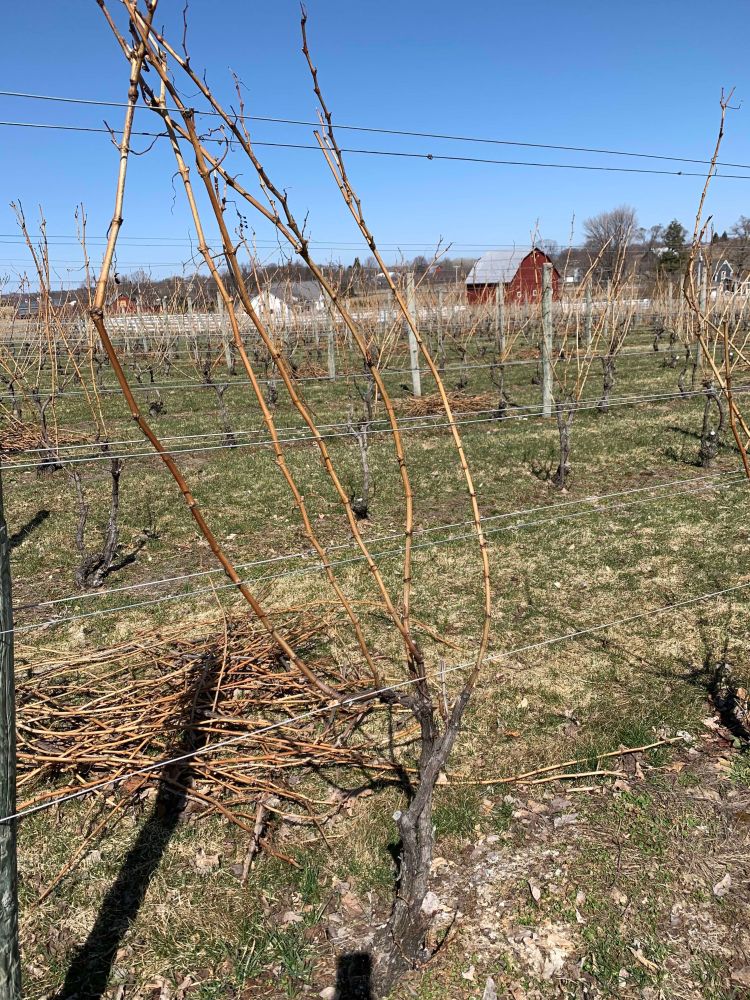
Pruning is more than a winter operation
As the growing season ends and grapevines enter dormancy, many Michigan growers are eager to begin pruning as early as December. The reasoning is understandable: pruning is labor-intensive, vineyard acreage must be managed efficiently, and completing part of the work before the new year can reduce the workload during the busy months preceding budbreak. December pruning may appear particularly attractive when weather conditions are favorable, and vineyard crews are available. However, what makes sense from a labor-management perspective may not always be the best decision for vine health and long-term productivity.
In Michigan, December is still the beginning of winter, and some of the most damaging freezing events may occur during January, February, or even early March. Pruning vines before these events exposes growers to an important risk: removing potentially productive buds and canes before knowing how much winter injury the remaining tissues will experience. Once vines have been pruned to their final bud number, growers have limited opportunities to compensate for subsequent bud mortality. This is especially important for cold-sensitive Vitis vinifera cultivars, including Merlot, Pinot Noir, Chardonnay, and Cabernet Franc, which may experience substantial primary bud mortality during severe winter events. Although pruning in December does not necessarily reduce the intrinsic freezing tolerance of every retained bud, it eliminates much of the flexibility growers would otherwise have to adjust pruning severity after assessing winter damage.
The situation is different for many hybrid cultivars. Very cold-hardy hybrids, such as Marquette, Frontenac, and La Crescent, generally tolerate substantially lower midwinter temperatures than most vinifera cultivars. Consequently, December pruning may present a lower winter-injury risk for these cultivars, particularly in vineyards with a history of limited cold damage. However, not all hybrids are equally cold hardy. Moderately hardy hybrids, such as Vidal Blanc, Chambourcin, and Traminette, may still experience significant winter injury, and even very cold-hardy cultivars can be vulnerable to spring frost if they break bud early.
Pruning timing also raises questions beyond winter survival. Every pruning cut creates a wound that may become an entry point for fungal pathogens associated with grapevine trunk diseases. Pruning early in winter can leave wounds exposed to potential infection events over an extended period, although actual disease risk depends on pathogen activity, weather conditions, and the rate at which wounds become less susceptible. Conversely, delaying final pruning until late winter or early spring may provide opportunities to assess winter injury, adjust bud retention, and, under certain circumstances, postpone budbreak to reduce spring frost exposure.
The question, therefore, is not simply whether growers can begin pruning in December, but whether they should and which cultivars and vineyard blocks should be pruned first. Research suggests that the optimal pruning strategy must balance winter cold hardiness, spring frost risk, bud fruitfulness, vine productivity, grapevine trunk-disease pressure, and labor availability. Understanding these relationships is essential for developing pruning schedules that protect both the current season's crop and the long-term productive life of Michigan vineyards.
Cold hardiness: Why vinifera and hybrids require different pruning strategies
Grapevine cold hardiness is a dynamic physiological characteristic. During fall, grapevines progressively acquire freezing tolerance through cold acclimation. Maximum cold hardiness is generally achieved during midwinter, followed by gradual deacclimation as temperatures increase toward spring. The degree of cold hardiness depends on cultivar genetics, previous growing conditions, carbohydrate reserves, tissue maturity, and environmental conditions. Importantly, the same minimum temperature may cause severe damage to one cultivar and relatively little injury to another.
Traditional Vitis vinifera cultivars, including Chardonnay, Pinot Noir, Cabernet Franc, Riesling, and Merlot, are generally less cold hardy than many interspecific hybrids developed for northern growing regions. However, substantial variation also exists within vinifera. Cabernet Franc and Riesling generally possess greater midwinter freezing tolerance than cultivars such as Merlot and Pinot Gris.
Hybrid cultivars are even more diverse. Moderately cold-hardy hybrids, including Vidal Blanc, Chambourcin, Traminette, and Chardonel, may tolerate lower winter temperatures than many vinifera cultivars, but they can still experience significant injury during severe Michigan winters.
In contrast, very cold-hardy hybrids such as Marquette, Frontenac, and La Crescent were developed to withstand substantially lower temperatures. Published Michigan State University Extension information illustrates the magnitude of these differences.
Table 1. Approximate midwinter temperatures associated with 80–100% primary bud mortality for selected grape cultivars. From “Cold hardiness of grapevines: The interplay of genetics, environment and management” (Sabbatini, 2024), adapted from Zabadal, Sabbatini, and Elsner (2008).
|
Cultivar |
Group |
Temperature (°F) |
|---|---|---|
|
Merlot |
Vinifera |
−9 |
|
Pinot Noir |
Vinifera |
−10 |
|
Chardonnay |
Vinifera |
−13 |
|
Riesling |
Vinifera |
−14 |
|
Cabernet Franc |
Vinifera |
−17 |
|
Traminette |
Hybrid |
−20 |
|
Vidal Blanc |
Hybrid |
−22 |
|
Chardonel |
Hybrid |
−22 |
|
Chambourcin |
Hybrid |
−23 |
|
Frontenac |
Very cold-hardy hybrid |
−35 |
|
Marquette |
Very cold-hardy hybrid |
−35 |
The potential difference between Merlot and Marquette is substantial, emphasizing why a single pruning calendar is not appropriate for all Michigan vineyards. Nevertheless, maximum midwinter cold hardiness should not be confused with overall resistance to spring freezing events. Some very cold-hardy hybrids may begin growth earlier in spring and consequently become vulnerable to frost after losing their winter hardiness.
Does early pruning increase winter injury?
Pruning during autumn or early winter removes buds and canes before the most severe winter temperatures have occurred. Once these tissues are removed, growers lose the opportunity to adjust the number of retained buds if subsequent freezing events cause extensive damage. Several research evaluated the effects of cane length and dormant pruning date. The researchers found that fall-pruned vines experienced greater spring bud mortality than unpruned vines. These findings highlight an important physiological distinction.
Early pruning does not necessarily reduce the freezing tolerance of every retained bud under all conditions. However, early pruning may increase the risk of observed winter damage and, perhaps more importantly, eliminates the opportunity to compensate for subsequent injury. The practical advantage of delaying pruning is therefore not simply that unpruned vines are always more cold hardy. Rather, delayed pruning preserves management flexibility until the principal period of winter injury has passed. This consideration is particularly important for vinifera cultivars, whose lower freezing tolerance increases the likelihood of significant primary bud mortality during severe winter events.
For very cold-hardy hybrids, the probability of severe midwinter injury may be considerably lower under typical Michigan winter conditions. Consequently, growers may have greater flexibility to begin pruning these cultivars earlier. Moderately hardy hybrids represent an intermediate situation. Their pruning priority should depend on cultivar-specific cold hardiness, vineyard location, and the severity of winter conditions. In all cases, final pruning decisions should reflect actual winter injury rather than assumptions based exclusively on cultivar classification.
Winter injury and the importance of secondary bud fruitfulness
Another important consideration is the ability of grapevines to recover crop production following primary bud injury. Each compound grapevine bud contains a primary, secondary, and tertiary growing point. Under normal conditions, the primary bud produces the most fruitful shoot. When the primary bud is killed by freezing temperatures, secondary buds may develop and produce replacement shoots. However, the contribution of these shoots to yield depends on cultivar-specific secondary bud fruitfulness.
Many vinifera cultivars exhibit relatively limited secondary bud fruitfulness, meaning substantial primary bud mortality can result in significant yield losses even when secondary buds survive. Some American-type grape cultivars and interspecific hybrids may produce more fruitful secondary shoots, allowing partial compensation following winter injury. However, secondary bud fruitfulness is cultivar-specific and should not be assumed to be greater in every hybrid than in every vinifera cultivar.
Cold hardiness and secondary bud fertility are separate biological characteristics. A highly cold-hardy hybrid may survive extreme winter temperatures but still produce relatively little fruit from secondary buds following a spring frost. Conversely, a less cold-hardy cultivar may retain some cropping potential after moderate primary bud damage if its secondary buds are sufficiently fruitful.
For this reason, the assessment of bud injury should consider not only the percentage of dead primary buds but also the survival and potential fruitfulness of secondary buds. This becomes particularly important when winter injury exceeds 50–60%, at which point management decisions may involve substantial adjustments to retained bud numbers or even the postponement of final pruning until new growth can be evaluated.
Managing winter-damaged vines: How much should growers prune?
In Michigan, severe winter cold events can cause extensive damage to primary buds, secondary buds, canes, cordons, and trunks. When significant winter injury is suspected, growers should sample representative canes from different vineyard locations and assess bud survival before completing final pruning. Bud samples should represent the cultivar, vineyard position, vine vigor, and anticipated fruiting nodes. Michigan State University Extension has published practical recommendations for adjusting pruning severity based on observed primary bud mortality.
Table 2. Suggested pruning responses based on primary bud mortality.
|
Primary bud mortality |
Suggested strategy |
|---|---|
|
10–15% |
Generally maintain standard dormant pruning. |
|
20–50% |
Retain approximately 20–30% additional buds or more, depending on injury and cultivar. |
|
Approximately 60% |
Consider retaining twice the normal number of buds. |
|
Greater than 60% |
Consider minimal or no dormant pruning; prioritize vine recovery and structure. |
|
Severe injury to trunks or cordons |
Focus on establishing healthy replacement wood and rebuilding the vine. |
For severely damaged vinifera vineyards, maximizing the immediate crop may be less important than preserving healthy trunks, renewal shoots, and sufficient leaf area to support recovery. Winter injury to the trunk and cordon is particularly important because it can reduce vascular function, disrupt vine growth, and contribute to long-term decline. Freeze-damaged trunks may also be more susceptible to crown gall development. In severely injured vines, retaining additional shoots or suckers temporarily may support photosynthesis and facilitate replacement of damaged trunks or cordons. Cold-hardy hybrids may require fewer pruning adjustments after winters in which damaging temperatures remain above their injury thresholds. However, following extreme cold events, they should be assessed using the same principles.
Delayed pruning and spring frost: Understanding the role of apical dominance
An additional reason to delay pruning is the possibility of postponing budbreak and reducing exposure to spring frost (Figure 1). Grapevines exhibit a growth pattern commonly described as acrotony, in which buds located near the distal end of a long cane tend to develop before buds closer to its base. This preferential development of distal buds can temporarily suppress the growth of basal buds. When growers retain long canes or spurs during early spring and subsequently remove the distal portion, the basal buds retained for production may begin growth later than those on vines that were pruned to their final bud number during winter. This mechanism forms the physiological basis of delayed pruning as a frost-management strategy.
Research conducted on vinifera cultivars has demonstrated that pruning timing can significantly influence early-season phenology. In a three-season study, pruning at budbreak delayed subsequent budbreak of the retained buds by approximately 10 days without reducing yield relative to conventional winter pruning. More advanced pruning treatments produced larger phenological delays but also significant reductions in yield. This distinction is particularly relevant to Michigan, where spring frost events frequently threaten emerging grapevine shoots.
For cold-sensitive vinifera, delayed pruning can potentially provide two benefits: preserving additional buds during winter and postponing early growth to reduce spring frost exposure. For very cold-hardy hybrids, the primary benefit may be different. Cultivars such as Marquette can withstand very low midwinter temperatures but may begin budbreak relatively early. This characteristic may expose developing shoots to damaging spring frosts despite their excellent winter hardiness.
Consequently, late pruning can be considered as a potential spring frost-management tool even in vineyards where midwinter cold injury is uncommon.
How late is too late? Effects on vine growth, yield and fruit maturity
Although delayed pruning can provide physiological advantages, postponing the final operation excessively may negatively affect vine productivity. Research clearly demonstrates that the consequences of late pruning depend strongly on the phenological stage at which the final cuts are performed. In the previously mentioned experiments, conventional winter pruning was compared with pruning at budbreak, at two to three unfolded leaves, and at eight unfolded leaves.
Table 3. Effects of delayed pruning on Malbec yield relative to conventional winter pruning.
|
Pruning stage |
Relative yield |
Yield reduction |
|---|---|---|
|
Dormant winter pruning |
100% |
0% |
|
At budbreak |
100% |
0% |
|
2–3 unfolded leaves |
83% |
17% |
|
8 unfolded leaves |
40% |
60% |
The study demonstrates that delaying final pruning until budbreak can postpone early development without necessarily reducing yield. However, delaying pruning until several leaves have expanded can produce substantial yield losses. For Michigan growers, the implications extend beyond yield. Late pruning can also alter the timing of flowering, veraison, and fruit maturation, potentially influencing berry composition at harvest.
Research demonstrated that post-budbreak pruning modified shoot development and ripening dynamics, including sugar accumulation and organic acid degradation. These responses may be desirable in warm-climate regions, where delaying ripening can help maintain acidity or moderate sugar accumulation. In Michigan's relatively short growing season, however, excessive delays in ripening may be undesirable, particularly for late-ripening vinifera cultivars or vineyards that already struggle to achieve adequate maturity.
An additional consideration is that post-budbreak pruning removes tissues that have already begun growing using stored carbohydrate reserves. When final pruning is postponed until substantial shoot growth has occurred, the vine loses developed photosynthetic structures and must support the growth of replacement shoots. Although the effects on reserves and long-term productivity depend on pruning severity and environmental conditions, repeated severe post-budbreak pruning warrants caution.
The situation may differ for early-ripening hybrids that typically reach adequate maturity before the end of the season. The practical objective should therefore be to delay final pruning enough to reduce risk, but not so much that vine productivity and fruit maturity are compromised.
Pruning timing and grapevine trunk diseases: A second major consideration
Pruning timing also influences grapevine health through its effects on susceptibility to fungal pathogens associated with grapevine trunk diseases. These diseases include Eutypa dieback, Botryosphaeria dieback, and the Esca disease complex. The pathogens responsible for these diseases can enter grapevine wood through pruning wounds, establish infections within woody tissues, and progressively compromise vascular function. Over time, infected vines may exhibit poor shoot growth, reduced productivity, branch dieback, and eventual vine decline. Pruning wounds are therefore an important component of vineyard disease management.
A quantitative synthesis published recently examined the susceptibility of pruning wounds to fungal infection using experimental data from the scientific literature. The analysis demonstrated that pruning wounds are highly susceptible immediately after they are made and can remain vulnerable to infection for several months.
The study also identified important differences among pathogen groups, cultivars, and pruning periods. Infection incidence associated with Botryosphaeria dieback pathogens was higher than that associated with Eutypa dieback pathogens under the experimental conditions represented in the analysis.
Wound susceptibility also tended to decrease more rapidly for Eutypa-associated pathogens than for some other trunk-disease fungi. Pruning season influenced infection dynamics, with late-dormant-season pruning associated with lower initial infection incidence than midseason pruning in the analyzed dataset.
These findings support the importance of pruning timing as part of an integrated disease-management strategy. However, pruning later does not eliminate the possibility of infection. The risk of trunk-disease infection depends on the interaction among wound susceptibility, pathogen availability, and environmental conditions. Rainfall and wet weather can promote the dispersal of fungal spores. Therefore, fresh pruning wounds exposed to rain shortly after cutting may experience increased infection pressure.
For Michigan vineyards, the timing of pruning should consequently consider short-term weather conditions in addition to cultivar hardiness and bud development. Whenever possible, growers should avoid pruning immediately before anticipated periods of rain or persistent wet conditions.
The use of registered pruning-wound protectants should also be considered in vineyards with a history of trunk disease or where disease pressure is elevated.
Are vinifera and hybrids equally susceptible to trunk diseases?
Differences in winter cold hardiness between vinifera and hybrids do not necessarily indicate corresponding differences in susceptibility to grapevine trunk diseases. Although many studies have investigated trunk diseases in vinifera cultivars, interspecific hybrids are not immune to wood-colonizing pathogens. Their susceptibility may differ according to genetic background, wound characteristics, vine architecture, and environmental conditions.
Cold-hardy hybrids may experience less freeze-related damage to permanent woody tissues, potentially reducing one contributor to long-term vine decline. However, this does not imply that their pruning wounds are resistant to fungal infection.
Furthermore, the available scientific literature provides relatively limited comparative information on the susceptibility of individual Michigan-grown hybrid cultivars to grapevine trunk-disease pathogens. Until more cultivar-specific research becomes available, prudent pruning-wound management should be applied to both vinifera and hybrids.
An additional concern in Michigan is the interaction between winter injury and vine decline. Severe freezing events can injure the cambium and other vascular tissues, making it more difficult to distinguish the effects of cold damage from those of fungal trunk diseases. For this reason, accurate diagnosis and the removal or replacement of seriously damaged wood are essential components of long-term vineyard management.
Double pruning: A practical compromise between biology and labor
The recommendation to delay final pruning creates a practical challenge for commercial vineyards. Growers managing large acreages cannot necessarily complete all pruning operations during a short period immediately before budbreak. Double pruning offers an opportunity to distribute labor while preserving some of the physiological advantages of later final pruning. The technique divides pruning into two operations. During the first stage, usually completed while vines are dormant, excess growth is removed while leaving additional cane length or more buds than will ultimately be retained. During the second stage, final pruning is completed later, reducing the remaining canes or spurs to the desired number of buds.
The strategy can serve several objectives. First, it allows growers to postpone final decisions about bud retention until winter injury has been evaluated. Second, leaving distal buds during spring can delay the development of basal buds that will be retained for production. Third, when preliminary cuts are made sufficiently far from the permanent vine structure, final pruning can remove potentially colonized wood associated with the initial pruning wounds. Fourth, preliminary mechanical pruning may reduce the amount of labor required for final hand pruning during the narrow late-winter or early-spring period. However, double pruning requires careful execution.
The technique is particularly straightforward in spur-pruned, cordon-trained vineyards, where preliminary pruning can leave long spurs that are subsequently shortened. In cane-pruned systems, growers must preserve suitable fruiting canes and avoid removing wood needed for the final vine structure. There is also an important distinction between double pruning for labor and disease management and delayed pruning specifically intended to postpone budbreak. A preliminary operation followed by final pruning while all buds remain fully dormant may distribute labor and preserve winter-injury management options, but it will not necessarily generate a significant delay in basal budbreak.
To exploit acrotonic growth for frost avoidance, sufficient distal buds must remain until those buds begin developing. The final pruning operation must then be carefully timed to avoid excessive crop losses. For cold-sensitive vinifera, double pruning can help manage both winter injury and spring frost risk. For early-bud-breaking cold-hardy hybrids, the principal objective may be spring frost avoidance rather than winter injury prevention. For moderately hardy hybrids, both objectives may be relevant, depending on site conditions. The additional cost and logistical demands of two pruning passes must be evaluated against the potential benefits, particularly in vineyards with limited labor availability.
Establishing pruning priorities in Michigan vineyards
Because cultivar cold hardiness and spring development differ, an effective pruning schedule should prioritize vineyard blocks according to risk rather than treating all cultivars equally.
Table 4. Suggested pruning priorities for different grape cultivar groups in Michigan
|
Cultivar group |
Examples |
Principal considerations |
Suggested strategy |
|---|---|---|---|
|
Cold-sensitive vinifera |
Merlot, Pinot Noir, Chardonnay, Pinot Gris |
High winter injury risk; potential spring frost exposure; trunk-disease concerns |
Prioritize delayed final pruning until late winter or early spring. |
|
Relatively hardier vinifera |
Riesling, Cabernet Franc |
Greater cold tolerance than some vinifera, but still vulnerable during severe winters |
Prune after cold-hardy hybrids, adjusting timing to site and injury history. |
|
Moderately cold-hardy hybrids |
Vidal Blanc, Chambourcin, Traminette, Chardonel |
Moderate winter injury risk; cultivar-specific budbreak and secondary bud fertility |
Use an intermediate pruning window and assess injury after severe events. |
|
Very cold-hardy hybrids |
Marquette, Frontenac, La Crescent |
Lower midwinter injury risk; potentially early spring development |
Can often be pruned earlier, but delay final pruning on spring frost-prone sites. |
A practical seasonal approach
November–December: Planning and assessment
Use this period to evaluate vineyard conditions, cane maturity, vine vigor, and the previous season's performance. Identify blocks with a history of winter injury, crown gall, or trunk disease. Avoid unnecessary early final pruning of cold-sensitive cultivars, especially where severe winter temperatures are common.
January–February: Preliminary pruning and hardier cultivars
Where labor requirements necessitate winter pruning, begin with the hardiest cultivars and vineyards with historically low winter injury risk. Preliminary pruning can be performed in suitable blocks, while retaining additional buds or cane length for later adjustments. Continue monitoring minimum temperatures, cold-hardiness estimates, and potential winter injury.
March–early April: Final pruning of vulnerable vineyards
As the risk of severe midwinter freezing diminishes, prioritize final pruning of the most cold-sensitive vinifera cultivars and moderately hardy hybrids. Where winter injury is suspected, assess bud survival before determining final bud numbers. Consider rainfall forecasts and the risk of trunk-disease infection when scheduling pruning operations.
Approaching budbreak: Carefully managed final pruning
Complete delayed final pruning in blocks where budbreak postponement is desired, including early-bud-breaking hybrids exposed to spring frost risk. Avoid excessive delays into advanced shoot development, when the removal of growing tissues may significantly reduce yield or affect fruit maturity. The exact dates will vary among southwestern Michigan, the Lake Michigan Shore region, northwest Michigan, and other growing areas. They will also vary from year to year according to winter weather and spring temperature patterns.
How should Michigan growers decide when to prune?
A practical pruning decision should consider five major factors.
- Cultivar cold hardiness.The most cold-sensitive cultivars should generally be pruned after hardier cultivars, preserving the opportunity to assess winter injury.
- Winter temperature history.Severe freezing events, particularly following periods of warmer weather, justify delaying final pruning until bud damage can be evaluated.
- Spring frost exposure and budbreak timing.Early bud-breaking cultivars, including some very cold-hardy hybrids, may benefit from delayed final pruning even when winter injury risk is relatively low.
- Grapevine trunk-disease pressure.Pruning should minimize unnecessary wounds and, when practical, avoid periods when conditions favor fungal spore dispersal and infection.
- Labor availability and training system.Vineyard size, pruning method, and equipment availability determine whether delayed pruning or double pruning can be implemented economically.
These considerations should not be evaluated independently.
For example, a cold-sensitive Merlot vineyard with a history of winter injury and trunk disease may benefit from delaying final pruning until late winter, whereas a cold-hardy Frontenac vineyard with little history of winter injury may be pruned earlier to improve labor distribution. However, a Marquette vineyard on a spring frost-prone site may justify a later pruning strategy despite its excellent midwinter hardiness. Similarly, a vineyard with substantial pruning-wound disease pressure may benefit from a pruning schedule that emphasizes dry weather and appropriate wound protection, even if these considerations require adjustments to the ideal physiological timing. The goal is to establish a hierarchy of risks and schedule pruning accordingly.
The best pruning date depends on the cultivar and the risk
In Michigan, pruning should not be considered simply an operation to be completed between leaf fall and budbreak. Its timing can influence winter injury management, spring development, crop productivity, fruit maturation, and the long-term health of the vineyard. Research demonstrates that delaying final pruning can preserve the opportunity to compensate for winter damage and, when appropriately managed, postpone budbreak to reduce exposure to spring frost. However, excessive post-budbreak delays may reduce yield and alter fruit maturation, particularly in vinifera cultivars growing under short-season conditions.
Pruning timing also influences disease pressure because newly created wounds are important infection sites for grapevine trunk-disease pathogens. Consequently, disease-management considerations should be incorporated into pruning decisions for both vinifera and hybrid cultivars.
For cold-sensitive vinifera, the primary advantage of late pruning is often the opportunity to assess winter injury and preserve productive buds. For moderately hardy hybrids, pruning decisions should balance winter injury risk with cultivar-specific spring development. For very cold-hardy hybrids, early pruning may be operationally practical, but early budbreak and spring frost exposure can still justify delaying the final operation.
Double pruning offers a useful compromise for vineyards requiring a longer operational window, provided that the technique is adapted to the training system, cultivar characteristics and management objectives.
The best time to prune grapevines in Michigan is not necessarily the latest possible date, nor the earliest date when labor is available. It is the time that best balances cold injury risk, spring frost exposure, vine productivity, disease pressure, and the practical requirements of vineyard management.
Ultimately, successful pruning begins with understanding not only how many buds to retain, but also why and when those decisions should be made.

