Sarah Mills, PhD, receives MSU Extension Key Partner Award
 Print
 Email
Sarah Mills has been honored with the Key Partner Award for role in advancing local government renewable energy planning and policy.
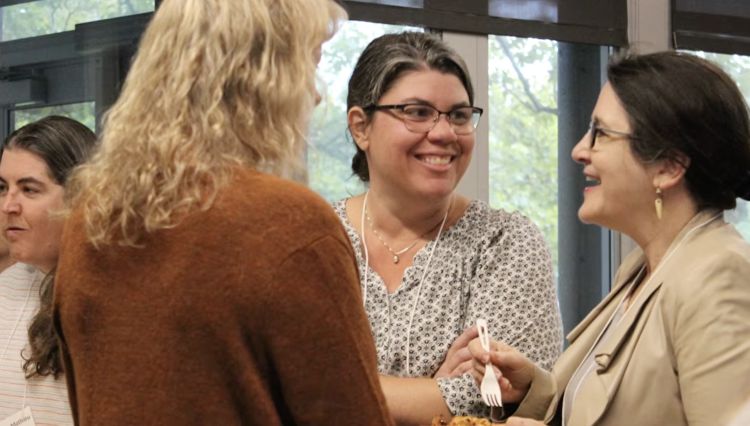
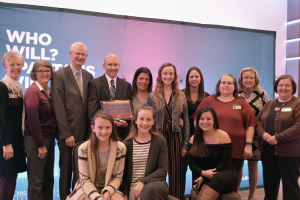
Sarah Mills has been honored with the Key Partner Award for her role in authoring and updating Michigan’s leading planning and zoning guidebooks for wind and solar energy, while also fostering cross-sector partnerships and convening regional and multi-state efforts. She accepted the award during the Fall Extension Conference, which took place Oct. 20-22, 2026, at the Kellogg Hotel and Conference Center in East Lansing, Michigan.
The Key Partners Award is given annually to individuals and organizations that have made significant contributions to creating, improving or promoting Extension programs.
Brad Neumann, a senior Extension educator for MSU Extension, nominated Mills.
"Sarah Mills has proven to be an extraordinary collaborator whose decade-long partnership with MSU Extension has fundamentally advanced renewable energy programming across Michigan,” he said.
Mills sought out MSU Extension in 2017 as a postdoctoral fellow at the University of Michigan’s Center for Local, State and Urban Policy. Recognizing that a partnership could bring the latest renewable energy research to Michigan residents and local officials, she shared educational materials on wind energy siting and regulation and offered to peer-review MSU Extension’s resources.
A tangible outcome of her leadership is the co-authored resource, “Planning and Zoning for Solar Energy Systems: A Guide to Michigan Local Governments.”
Released in 2022, Mills ensured this first-of-its-kind visual guide was printed and mailed to every local government in Michigan.
After publishing the guidebook, Mills actively partnered with MSU Extension in a statewide educational series to help local officials better understand their renewable energy policy and regulations. Her partnership and ability to secure funding have resulted in MSU Extension receiving nearly $500,000 across three grants to focus on renewable energy education and policy.
"Quite simply, she has made us better,” Neumann said. “She has made our programs better. She's made our materials better. She's helped us build our network."
Ultimately, Mills is committed to supporting rural prosperity and believes in the role community education plays in improving lives. Whether she is responding to concerned citizens or helping local officials plan for emerging infrastructure, her valued work ensures Michigan’s transition to renewable energy is grounded in community benefit and informed decision-making.