Recognizing Research and Community Partnership: Early Career Award Highlights Work to Improve Health and Wellbeing in Flint
 Print
 Email
Michigan State University 1855 Assistant Professor Samantha Gailey receives Early Career Award for work in health and natural resources.
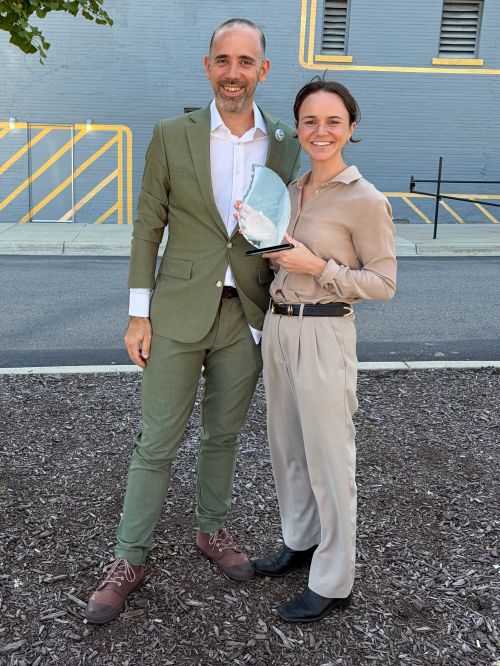
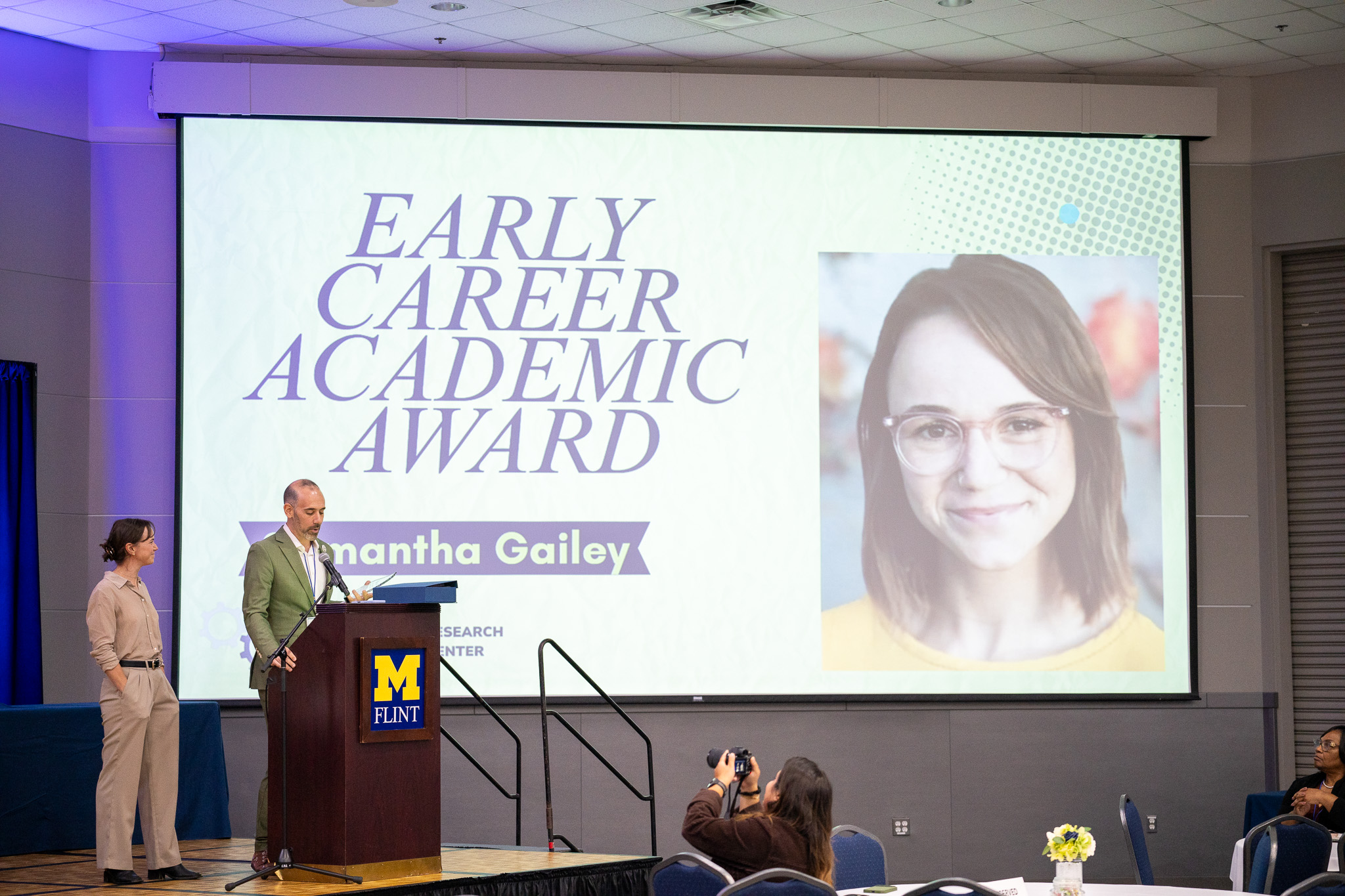
The Early Career Award from the Healthy Flint Research Coordinating Center (HFRCC) recognizes contributions made within the first ten years of a career, amplifying both accomplishments to date and the potential for future contributions. “I'm particularly honored to receive this recognition from the HFRCC, given its emphasis on research conducted in partnership with, rather than simply about, the Flint community,” said Gailey. Two examples illustrate Gailey’s work in Flint that led to this recognition.
Flint Registry and the new Flint State Park
The Flint Registry launched in 2018 under the leadership of pediatrician Dr. Mona Hanna to support individuals and families affected by the Flint Water Crisis. Its primary purpose is to connect residents with services that can help mitigate the health consequences of lead exposure, including healthcare, child development services, nutritional assistance, and lead elimination programs. The Registry also tracks longer-term health and developmental outcomes, providing valuable information to guide public health efforts and support epidemiologic research.
Gailey led a study with colleagues at the Flint Registry examining residential mobility following the Flint Water Crisis. The study found substantial racial differences in out-migration, with White residents more than three times as likely as Black residents to move away from Flint following the crisis. This finding suggests that the ability to leave a community affected by an environmental crisis is itself unequal, potentially reinforcing existing inequities in environmental conditions and health. It also highlights the importance of recovery efforts that account for these differences, particularly for residents who may have insufficient resources to move or otherwise prefer to remain in their communities.
The Flint River, central to the water crisis, is now also the focus of a major investment in environmental restoration and recreation: a new, 234-acre state park that stretches along three miles of the river. With support from the C.S. Mott Foundation, Gailey leads a research project evaluating the health and equity implications of this investment. The first study, led by Gailey’s doctoral student Tasha Siame, examined disparities in park access and use among Flint residents prior to the park’s completion. This work provides a baseline for evaluating how improvements to urban greenspace may affect park equity and residents' health over time.
The work is ongoing, with Gailey’s team continuing to use Flint Registry data, surveys, and a substantial repository of environmental data to examine relations between urban greenspace and health. One study, led by graduate student Abby Ording in Gailey’s Growing Environmental Equity in Neighborhoods (GREEN) Lab, examines how different dimensions of greenspace, including park quality, tree canopy, and vacant land, relate to mental health. The group is also launching a biomarker study examining relations between greenspace and biological measures of stress, aging, and inflammation, and developing a public-facing Flint Parks and Greenspace Dashboard to help residents explore local parks and inform future investments.
Looking toward the near future, Gailey’s team hopes to build on the generous support of the C.S. Mott Foundation by securing federal funding for a follow-up study. This study would evaluate whether improvements to the state park lead to changes in residents’ biological, mental, and physical health, and whether these benefits are equitably distributed. The scale of the investment, particularly in a city that has experienced decades of disinvestment, presents a rare opportunity to rigorously evaluate the health impacts of urban greening. Findings could help inform similar investments in historically underserved communities across the country.
Beyond its significance for research, the new state park also holds considerable promise for Flint residents. A substantial body of research demonstrates the benefits of parks and greenspace for physical and mental health, including through increased physical activity, social interaction, and stress reduction. “I hope the new Flint State Park will provide these benefits to residents, particularly those who have historically had limited access to high-quality greenspace. Beyond these direct health benefits, I also hope the investment helps rebuild the community's relationship with the Flint River and the natural environment and contributes to restoring trust in public institutions following the water crisis,” said Gailey.
Rx Kids
Beyond her work on the Flint Registry and new state park, Gailey’s research continues to build on connections established in Flint while expanding to address health across Michigan. One example is her involvement in research evaluating Rx Kids, an innovative maternal and infant health program that launched in Flint in 2024 and has since expanded to more than 60 communities across Michigan. The program provides $1,500 during pregnancy and $500 per month for the first 6-12 months of an infant's life, with the goal of improving family economic security and maternal and infant health. Working with colleagues at MSU's MIRACLE Center and the Rx Kids research team, Gailey is studying whether these cash transfers improve housing stability and neighborhood mobility, and whether these residential changes contribute to better birth outcomes and maternal health. As Rx Kids grows, this research could provide important evidence to inform maternal health and housing policies in Michigan and beyond.
“I'm honored to receive this recognition, particularly from an organization like the HFRCC that places community engagement at the very center of its mission. For me, the award is a reminder that good research requires more than scientific rigor: it also requires ensuring that community members have a seat at the table in shaping the questions we ask, how we conduct research, and how the findings are used. I hope to carry that commitment forward throughout my career,” said Gailey.
The Early Career Scholar Award recognizes two individuals each year, one from the community and one from an academic institution. Gailey would also like to recognize this year's community recipient, Melissa Hertlein of the Genesee County Land Bank, with whom Gailey is currently collaborating on research examining relations between urban nature, vacant land, and mental health in Flint. Gailey would also like to thank Dr. Dick Sadler, a close collaborator and Flint native, for the nomination.