


Reasonable custom work rates with higher diesel prices
 Print
Print Email
EmailHow to account for higher diesel prices in custom work rates.
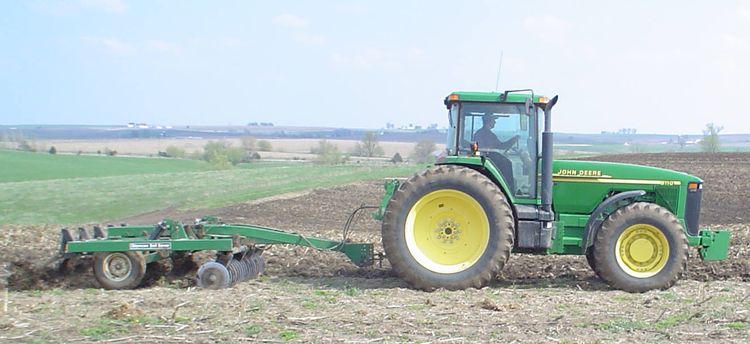
What is a reasonable custom work rate to charge and still cover higher fuel costs? This is common question farms are asking as record-high diesel prices continue to impact profitability.
Many farms utilize custom operators to manage operating costs while others offer custom work as a means to offset equipment purchases. Setting expectations in a time of higher costs is important for all farms regardless of whether you’re hiring the work done or the one for hire.
Adjusting work rates starts with understanding the fuel use and the field operation involved. With this information, you can start to navigate how much fuel is being used and your increased fuel cost per acre.
To begin that process, you need a few key pieces of information:
- Today’s price per gallon of fuel
- Previous price per gallon of fuel for comparison
- Fuel consumption per hour
- Width of implement
- Field efficiency of implement based on intended use and potential capacity
Once you have the list of information, it’s best to start with the fuel consumption per hour.
Fuel consumption per hour
Fuel consumption by hour focuses on the powerhouse being used. Powerhouse refers to the engine that is performing the field operation. Sometimes it’s the actual machine (combine) or what’s pulling the implement (tractor). Engines are expected to use the same amount of fuel for a given speed and throttle setting.
The two most commonly referred to speeds are power takeoff (PTO) and maximum power. PTO speed is a reduced throttle setting that uses less fuel. Maximum power speed is the highest throttle setting that uses the most fuel. These engine speeds determine the amount of fuel consumption by hour or gallons per hour of use.
To find gallons per hour for a given model tractor, lab tests are preferred. The University of Nebraska-Lincoln Tractor Testing Lab has records of various tests performed on a wide variety of makes and models. Their reports list fuel consumption ratings for both the PTO and maximum power speeds.
For example, a common tractor still used today is an International Harvester 1066 diesel tractor that was tested in 1973. It was rated at 7.283 gallons per hour at PTO speed and 8.419 gallons per hour at maximum power.
Note: If testing information is not available, a standard calculation of maximum horsepower for diesel engines multiplied by a factor of 0.044 can be used as a general rule of thumb.
To identify the fuel costs, simply multiple the gallons per hour by the price of diesel fuel. For example, a December 2025 diesel price is listed at $3.03 per gallon. The 1066 tractor’s PTO speed of 7.283 gallons per hour multiplied by the fuel price equals $22.07 per hour (7.283 x $3.03).
Alternatively, an October 2026 diesel price is listed at $5.82 per gallon. The same tractor PTO speed of 7.283 gallons per hour would still be used. The updated cost per hour would be $42.39 (7.283 x $5.82). A difference of $20.32 per hour is calculated based on diesel fuel price changes between December to October ($42.39 - $22.07).
Lubrication costs should also be factored into the fuel consumption estimates. Engine oil, hydraulic oil and grease are a few examples of lubrication costs. For ease of calculation, an additional 10% to 15% of fuel costs can be added to account for these expenses.
Using the December 2025 price, an additional 10% would be $2.21 added for a total of $24.28. The October 2026 price would have an additional 10% or $4.24 added for a total of $46.63.
The updated difference is $22.35 in cost per hour ($46.63 - $24.28).
The fuel consumption cost per hour provides the baseline for fuel use. The next step is to consider the acres per hour in the actual field operation.
Field operation acres per hour
Field operations consider the width of the implement or activity and the speed of the operation (in miles per hour). Field efficiency of the implement based on intended use and potential capacity is also considered.
Measured as a percentage, field efficiency is an offset for turns, delays or even overlaps between field passes. Iowa State University bulletin a3-24 provides a listing of field efficiency values for different types of operations.
To find acres per hour, width, speed and field efficiency are multiplied together and then divided by a conversion factor of 8.25. The conversion factor is based on a 1 acre by 1 mile to determine the final acres per hour value.
For example, a John Deere 1590 no-till drill is 15 feet wide and pulled across a field at a speed of 6 miles per hour. Iowa State University does not have a listing for no-till drills but does list 70% for grain and soybean drills.
Using the following equation, the drill is able to plant 7.64 acres per hour:

Now that the acres per hour of the field operation is identified, you can identify the custom work rate increase needed to cover the higher fuel cost.
Final step: Identifying the custom rate increase
The final step is to combine the differences in fuel consumption per hour and the field operation acres per hour. The calculation will provide you with the means to compare old versus new fuel costs per acre. This comparison answers the question of what to set custom work rates at to cover the additional fuel cost.
Based on the example information, the 1066 tractor’s powerhouse fuel cost of $22.35 represented the difference between December and October diesel fuel prices. The acres per hour for the 1590 no-till drill calculated at 7.64.
To identify the increased cost per acre, divide $22.35 by 7.64, which equals $2.93 per acre.
Therefore, the custom work rate for a 1590 no-till drill pulled by a 1066 tractor should be increased by a minimum of $2.93 per acre. The increased rate accounts for higher diesel fuel costs as shown in the example.
Using these steps can help to determine increases to custom work rates for your individual farm. They can also help to understand increases from farms you hire for custom work. Additional consideration should also be given to any cost increases for labor, repairs and other operating or ownership costs.
For more information on custom rates or calculating field operation costs, review Michigan State University Extension’s Custom Work Rates Report and Bulletin E-3515 Used Farm Equipment Markets: Planning the Purchase.

