Putting a price on pig health: How much more will shoppers pay?
 Print
 Email
Bigger improvements in pig health and welfare earn bigger price premiums, but not every improvement is valued the same.

Precision livestock farming, or PLF, gives farmers a closer look at every pig. Cameras and sensors can flag a pig that is sick, hurt or stressed long before a person might notice. Early action can mean healthier, calmer pigs.
But buying and running these tools is not cheap. If farmers invest in PLF to improve pig welfare, will shoppers help cover the cost? And does it matter how much the pigs' lives improve? To find out, we asked 4,004 U.S. pork shoppers to make a series of buying choices.
How the study worked
Each shopper picked between two packages of fresh pork loin or chose to buy neither. Each package carried labels with one to three stars. The stars showed how much PLF had improved three areas of pig welfare:
- Physical health: good food, a clean pen, daily care and quick vet treatment
- Mental health: less fear, stress and suffering, and more positive feelings
- Natural behavior: space and chances to explore, root, play and rest
Each area could show no improvement, or a low, moderate, or great improvement. The packages also differed in price, U.S. origin, and a carbon-neutral label. From the choices people made, we estimated how many extra dollars per pound they would pay for each improvement.
Bigger improvements, bigger premiums
The pattern was clear. The more PLF improved the pigs' lives, the more shoppers would pay (Figure 1).
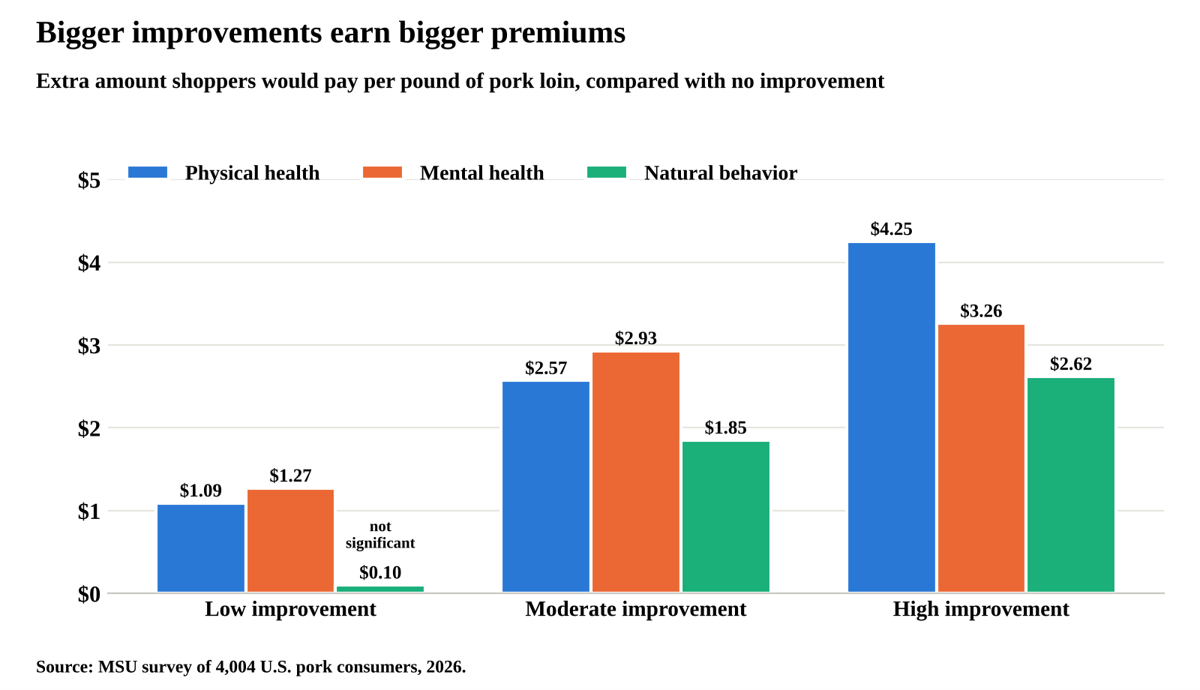
For physical health, shoppers would pay about $1.09 more per pound for a low improvement. That rose to $2.57 for a moderate improvement and $4.25 for a high improvement. For mental health, the premiums were $1.27, $2.93 and $3.26. For natural behavior, shoppers were willing to pay $0.10, $1.85 and $2.62 more for low, moderate and high improvement, respectively.
Small steps in natural behavior were not enough
One result stands out. Shoppers did not reward a low improvement in natural behavior. The $0.10 premium was so small that we cannot say it differs from zero. However, moderate and high improvements in natural behavior did earn solid premiums.
This suggests that shoppers want a real change in how pigs can move, explore and play. In their eyes, a small change may not be worth paying for.
The top prize: High physical health
A high improvement in physical health earned the largest welfare premium of all, at $4.25 per pound (Figure 2). High improvements in mental health ($3.26) and natural behavior ($2.62) also earned strong premiums.
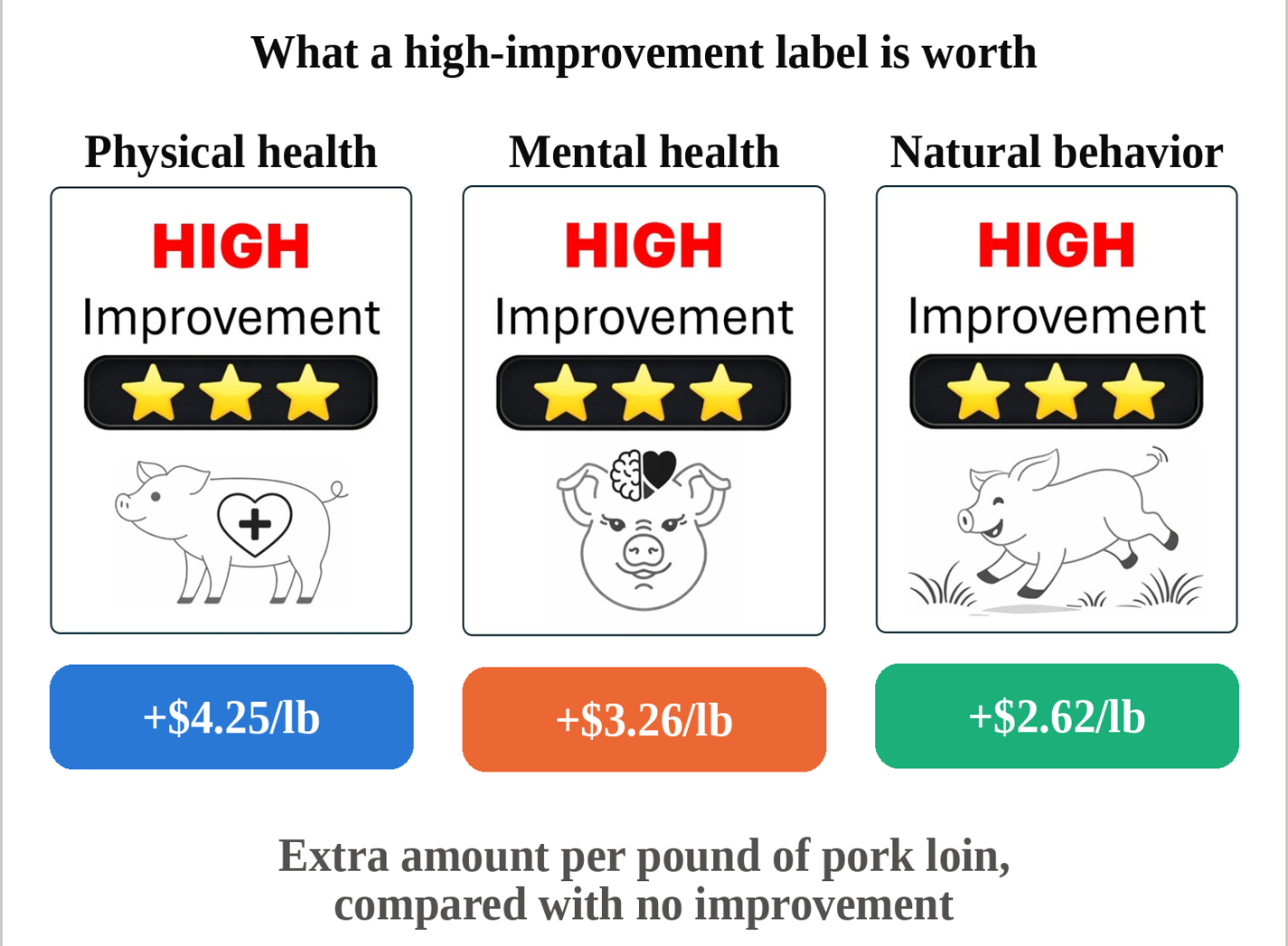
These premiums are large compared with the prices in our study, which ranged from $3.10 to $13.30 per pound. Keep in mind that these are survey results. Shoppers often say they will pay more than they actually spend in the store. Even so, the ranking of what people value is useful for planning.
What this means for farmers and tech companies
These results can help guide where to invest:
- Aim for big gains. High improvements earned about four times the premium of low improvements for physical health.
- Start with physical health. Tools that catch illness, injury and lameness early may offer the best payoff.
- Do not skip mental health. Even low and moderate gains in mental health earned premiums higher than the same gains in physical health.
- Go big on natural behavior. Only moderate and high gains were rewarded.
Shoppers in our study did not treat all welfare gains the same. They paid more for bigger improvements and valued strong gains in physical health most. For PLF to pay off, it should deliver changes that are large enough for shoppers to notice and value.
This work is supported by the Agriculture and Food Research Initiative [grant no. 2021 - 68014 - 34140] from the USDA National Institute of Food and Agriculture.