Nicole Ayache presents the 2026 Tucker Lecture
 Print
 Email
Collaboration is critical to dairy sustainability and growth.
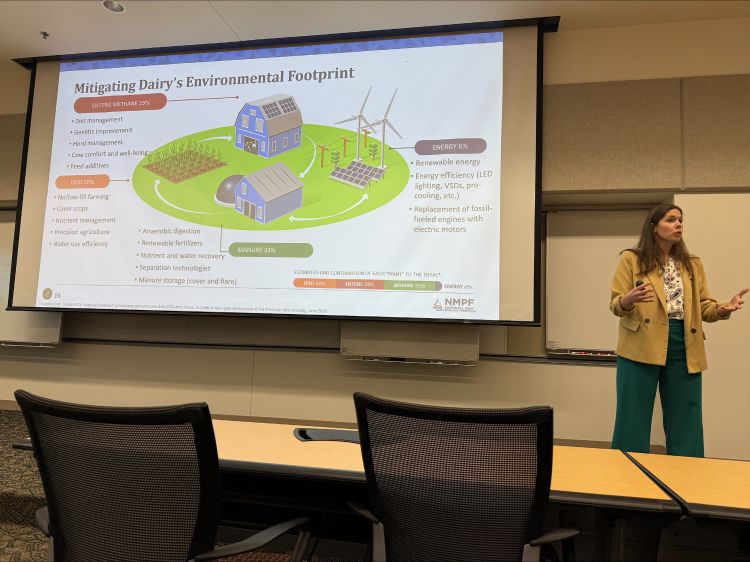
In October 2026, the Michigan State University Animal Science Department had the honor of hosting Nicole Ayache as the 2026 Dr. H. Allen and Ann Tucker Lecture speaker. Ayache is the Chief Sustainability Officer for the National Milk Producers Federation (NMPF), where she leads the organization’s sustainability strategy and oversees the Environmental Stewardship and Workforce Development components of the National Dairy Farmers Assuring Responsible Management (FARM) Program.
For Nicole Ayache, sustainability means meeting today’s generation's needs without compromising the ability of future generations to do the same. She emphasized that no single entity can drive progress alone. Instead, environmental stewardship is only made possible through active partnerships among dairy organizations, researchers, NGOs, companies and farmers to support four critical goals: resiliency, efficiency, revenue diversification and the social license to operate.
Dairy’s economic picture
Investment in new dairy processing continues to expand, the number of cows is growing and milk per cow continues to rise. Consumer demand for protein is driving high-protein whey prices higher, the dairy industry is producing a lot of cheese and export markets remain an opportunity for this increased production.
On the farm, margins are tighter. The Dairy Margin Coverage (DMC), which measures income over feed costs, has lowered as input costs rise and milk prices remain volatile. Depending on location, beef-on-dairy revenue is helping farms offset that volatility, and Ayache mentioned some operations rely on it to sustain the business. She expects short-term oversupply and continued volatility, with stabilization as new processing capacity comes online.
Shared tools for efficiency
Ayache called efficiency, doing more with less, a cornerstone of sustainability that minimizes inputs and reduces costs. Comparing 2017 to 2007, producing a gallon of milk required 30% less water and 21% less land, with a 19% smaller carbon footprint. She attributed much of that to productivity, animal health and feed efficiency improvements.
To track these ongoing improvements, the FARM Environmental Stewardship (ES) Program provides a measurement platform that many milk cooperatives and processors use to measure farm-level greenhouse gas footprints. It runs on the Ruminant Farm System (RuFas) model, a process-based model that links feed production, enteric emissions and manure.
Ayache said a single footprint means little on its own and insights come from measuring repeatedly and tracking trends. An energy footprint above the national average may point to efficiency opportunities to save money, and a high manure footprint may point to nutrient or manure management opportunities. In addition, FARM ES includes scenario analysis, such as modeling the effect of adding a manure separator. Ayache described the platform as unbiased because NMPF does not sell the technologies being modeled. During the Q&A, she said her team is always happy to help teach farmers and consultants how to use the model.
Getting paid for stewardship
There are different avenues that dairy farmers get paid for their environmental efforts. Ayache said carbon markets and incentive programs won’t make or break a dairy farm business, but diverse revenue helps dairy farms manage volatility. Options include Farm Bill cost-share programs such as EQIP, tax incentives, state programs, compliance markets such as California’s and supply chain insetting markets (where companies invest in emission reductions directly with their own agricultural supply chains, rather than buying outside offsets).
Because each farmer knows what works best for their operation, a wide menu of options is what drives progress. An example is the USDA Advancing Markets for Producers (AMP) that funds practices on farms while piloting new markets so those practices can eventually pay for themselves.
Earning the trust of consumers
Dairy accounts for about 2% of U.S. greenhouse gas emissions, a number Ayache said surprises many people. Most consumers want to know dairy is safe, nutritious and affordable. Customers, meaning retailers, brands and food manufacturers, face pressure from shareholders and regulators, including California’s climate disclosure rules and European Union directives that reach any company doing business in Europe. Many of those buyers now build greenhouse gas reduction requirements into procurement decisions.
Ayache said much of NMPF’s work ensures customers have the information they need, and the FARM ES Program documents practices beyond emissions, such as water recycling. Consumer-facing work falls to Dairy Management Inc., which integrates sustainability messaging into marketing campaigns. Ayache described NMPF’s data as a safety net for that marketing, so dairy’s claims are backed by numbers.
Looking ahead: Collaboration is key
Every program Ayache described required multiple organizations. She said the path to implementation needs to be simpler. Carbon credits accounting rules can run hundreds or thousands of pages, and projects then require third-party approval, farmer enrollment and verification. Consistent, unified measurements simplify these efforts. The voluntary, incentive-based approach, unlike regulatory approaches in some other dairy markets such as herd reductions or enteric emission limits, allows faster progress because decisions are made at the farm level.
She described stewardship as a win-win and said none of NMPF's work would be possible without research and scientific backing. Describing the diversity of U.S. dairy operations, she said, "When you've been to one farm, you've been to one farm."