


Milk components are in demand in Michigan – Where is the supply coming from?
 Print
 Email
What consumers eat shapes the composition of milk that leaves dairy farms and at what price. Driven by low-carb and high-protein diet trends, the booming demand for butterfat and whey protein products has reshaped the dairy market over the last decade.
Here in Michigan, total milk production has consistently increased over the past 20 years to meet growing demand. To capture the value of milk components and handle increased milk volume, over a billion dollars is currently being invested to expand Michigan milk processing capacity, as highlighted in the Spartan Dairy Newsletter article “Michigan sees dramatic investment in dairy processing.”
However, this processing boom is happening alongside a long-term decline in the number of dairy farms in Michigan and nationally. With fewer farms, how are we meeting this increased demand? What exactly has driven the changes in Michigan's milk fat and protein production from the early 2000s to today?
There are three primary drivers of total milk component production: number of cows, milk yield per cow, and component concentrations in milk. We carried out a retrospective analysis to evaluate which of these factors has contributed most to increased milk fat and protein supply in Michigan over the past 25 years.
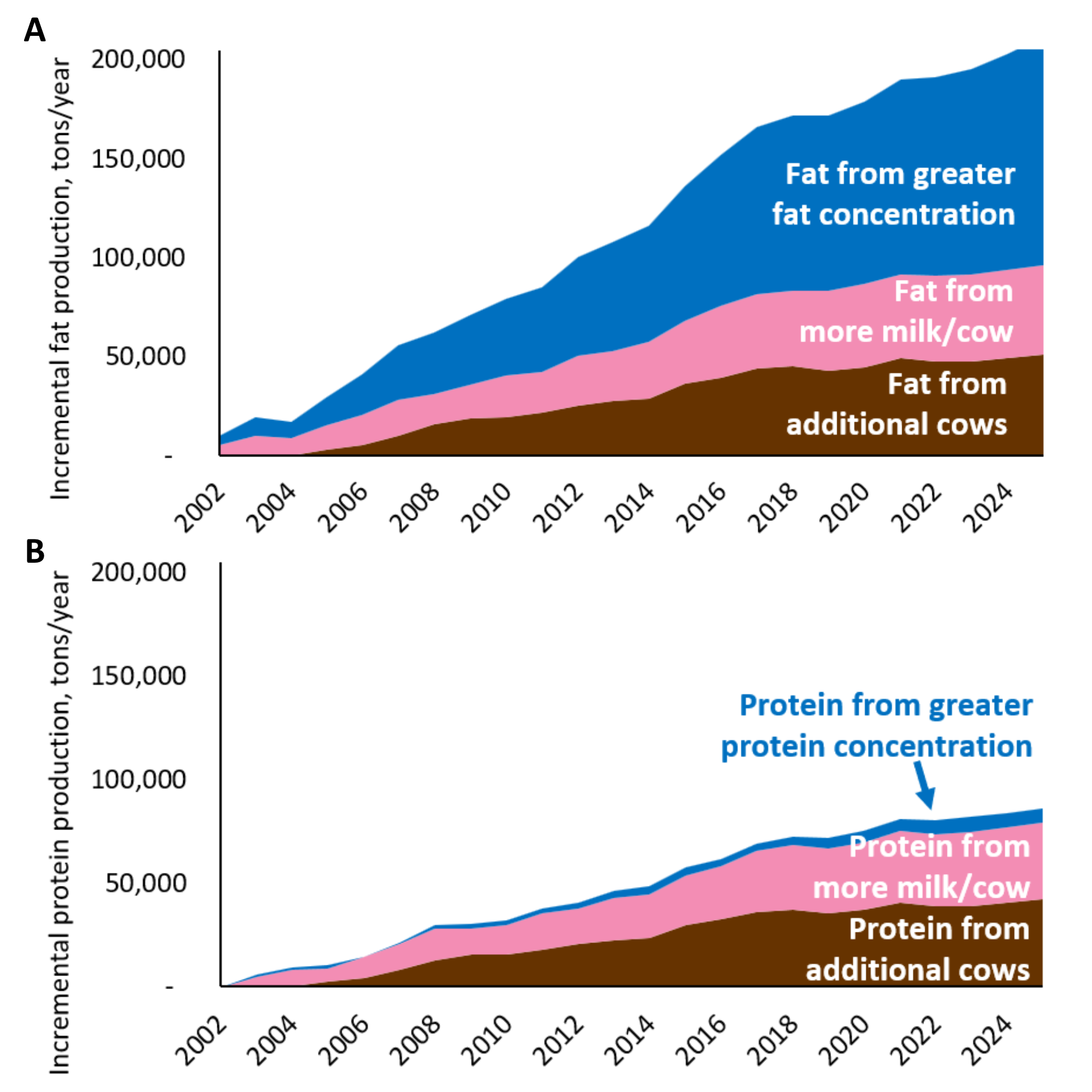
Protein yield data were obtained from the Council of Dairy Cattle Breeding, and additional data — including cow numbers, milk yield and fat yield — were sourced from the U.S. Department of Agriculture, National Agricultural Statistics Service (USDA NASS). Using these datasets, we estimated annual changes in fat and protein yield attributable to each factor by comparing every year to a baseline of 2001.
Over the past 25 years, increases in fat concentration and higher milk volume have consistently driven improvements in fat yield (Figure 1). Increasing cow numbers began contributing to fat yield growth around 2006, but changes in fat concentration remained the dominant factor.
Protein yield followed a different pattern. Increased milk volume was the primary contributor to additional protein supply early in the period, but beginning in 2006, cow numbers became a major driver (Figure 1B). Changes in protein concentration contributed little to growth in protein supply over 25 years, although there has been a modest improvement in the past decade. Cow numbers and milk volume contributed similarly to fat and protein yield growth over the past 25 years.
Improvements in genetics and feeding practices likely helped drive these changes. Selecting bulls for higher fat and protein production has helped farmers breed cows that produce more milk components. Genomic testing has made it possible to identify these animals at a younger age. Farmers and nutritionists have also improved diets to support component production; for example, balancing forage fiber and starch helps keep the rumen healthy and prevent low milk fat concentration, while certain fat supplements can increase milk fat yield. Providing enough energy and protein also supports milk protein production. However, milk protein concentration is much harder to change through feeding or genetics than milk fat concentration. Milk prices that reward fat and protein give farmers a reason to focus on these improvements.
Overall, individual cow performance has been a major driver in component production in the past 25 years, in addition to an increase in Michigan’s dairy cow population. There has been a shift in the last 5 years, where increasing component concentrations have been a larger contributor, especially for fat. As the demand for protein increases, will protein concentration be the primary contribution to increased protein supply in the future?
Unfortunately, based on our current understanding of milk protein synthesis, this is unlikely. To meet the growing milk protein demand from health-conscious consumers, we will likely have to depend on more cows and greater milk volume per cow.
This analysis was completed through the Evidence-Based Dairy Management Program through Michigan State University Extension. Our objective is to help dairy producers around the state of Michigan make better decisions on their farms by digging deeper into their own data. Are you a dairy producer who could use our help? Please share your question here.