


Michigan’s 2026 grape vintage: Spring frost injury, regional ripening and implications for fruit quality
 Print
 Email
An evidence-based assessment of the growing season, distinguishing observed vineyard conditions from hypotheses about fruit composition and eventual wine quality.
A vintage shaped by early-season injury and contrasting regional conditions
The quality of a wine-grape vintage is determined by interactions among cultivar, environment, vine physiology, and management. This principle is particularly relevant in Michigan, where spring frosts, regional differences in heat accumulation, and variable late-season weather can produce markedly different outcomes within the same year.
Émile Peynaud, French oenologist, researcher and University of Bordeaux professor widely regarded as the "father of modern oenology," observed that wine is “both a reflection of the people who make it and of the region that produces it.” His observation provides an appropriate context for evaluating the 2026 growing season: Weather influences the production environment, but management decisions affect how vines respond and whether fruit can be harvested at an appropriate maturity and sanitary condition.
Michigan’s 2026 growing season began with damaging freeze events in parts of southern Michigan and continued with pronounced regional differences in vine development, canopy growth, disease pressure, and fruit ripening. The available grape scouting reports from Michigan State University Extension documented promising September maturity in selected northwest Michigan Vitis vinifera cultivars and several cold-hardy hybrids in the Tip of the Mitt. They also document frost-related crop losses, delayed secondary-shoot development, downy mildew, and late-season cluster rots in other areas.
These observations describe vintage potential, not a completed statewide assessment of harvest quality or finished wines.
Spring frost: Severity, phenology and consequences for crop development
Early warmth advanced bud development in parts of southwest Michigan; some early bud breaking cultivars were as much as 14 days ahead of their long-term developmental averages during April. On April 7, minimum temperatures in the mid-20s degrees Fahrenheit injured susceptible tissues, especially in low-lying areas. MSU Extension reported a site-dependent range of 0–90% primary-bud injury among affected locations. A second frost on May 2, when many cultivars had developed green tissue, caused more than 75% primary-shoot loss at some sites, although nearby vineyards experienced little or no injury.
These figures describe the observed range of injury, not statewide mean losses. The damage depended on both temperature exposure and phenological stage. Midwinter cold hardiness is not equivalent to spring frost tolerance; even a highly cold-hardy hybrid may be vulnerable after deacclimation and shoot emergence. Conversely, a less cold-hardy vinifera cultivar may escape an early event if its buds have not yet developed exposed green tissue. Cultivar, elevation, cold-air drainage, bud stage, and duration of freezing all modify the outcome.
Following primary shoot loss, surviving secondary buds may initiate replacement shoots. Their contribution to yield depends on cultivar-specific secondary bud fruitfulness and the remaining season available for development. MSU Extension reported that by June 17, secondary shoots in frost-damaged southern vineyards were flowering while bloom had almost finished in unaffected juice-grape blocks. This phenological offset is important because later flowering and fruit set can lead to heterogeneous cluster development and a narrower period for full ripening before autumn.
Why reduced yield is not evidence of improved quality
A reduced crop may decrease reproductive sink demand, potentially increasing assimilate availability per surviving cluster. However, frost does not selectively remove fruit as a controlled thinning treatment would. It may simultaneously remove leaves, developing inflorescences and entire shoots. The vine must then allocate stored reserves and current photosynthates to canopy reconstruction.
Changes in fruit composition depend on the balance between remaining functional leaf area and retained fruit mass rather than on yield reduction alone. Where sufficient leaf area survives and fruit set is reduced, the source-to-sink ratio may favor ripening. Where extensive shoot injury forces secondary shoot regrowth, reduced early-season carbon assimilation, delayed flowering and uneven maturity may offset that advantage.
Weather and thermal accumulation: Interpreting regional variation
Regional weather observations indicate that April was unusually wet in southwest Michigan; precipitation of approximately 3–6 inches above normal in portions of that region. High moisture availability can support rapid canopy expansion but may also constrain field access, prolong leaf and cluster wetness, and increase the need for timely canopy and disease management.
July brought periods of heat and dryness in southwest Michigan. Wildfire smoke temporarily reduced incident solar radiation by about 25% over several days in mid-July. A short-lived reduction in radiation could affect canopy light interception and photosynthesis, but its contribution to 2026 grape composition has not been quantified. Smoke presence alone is not evidence of smoke-taint compounds in grapes or wine; such a conclusion would require appropriate exposure and chemical measurements.
MSU Extension’s scouting reports quantify these regional differences using growing degree days (GDD, base 50 F), which estimate the cumulative thermal energy available for plant development. On July 29, southwest Michigan had accumulated 1,828.6 GDD compared with 1,236.4 in northwest Michigan and 1,215.6 in the Tip of the Mitt AVA. By Aug. 26, the respective totals had increased to 2,406.8, 1,721.8, and 1,702.9 GDD. On Sept. 11, southwest Michigan had reached 2,780.1 GDD, northwest Michigan 2,007.5 GDD and the Tip of the Mitt 1,963.5 GDD. These values are reported as regional observations at specific dates, not final season totals or averages of all vineyards.
The temperature accumulation difference between southwest and northwest Michigan was approximately 592 GDD on July 29, 685 GDD on Aug. 26 and 773 GDD by Sept. 11. The widening absolute difference is consistent with greater cumulative heat availability in the south during the sampled interval, providing an explanation for why early grape cultivars were being harvested in southern vineyards while several northern vinifera cultivars were still progressing through veraison and ripening.
GDD should not be interpreted as a direct measurement of grape quality. It does not account for solar radiation, diurnal temperature amplitude, rainfall, vine water status or cultivar-specific responses to heat. Additional thermal accumulation may support the maturation of late-ripening cultivars; excessive heat, however, can accelerate malic acid respiration or contribute to berry stress under some conditions. The important question is whether a given cultivar can achieve the desired balance of sugars, acids, flavor and phenolic composition within the available season.
Southwest Michigan: Frost recovery, disease pressure and harvest risk
In southwest Michigan, the 2026 season combined the consequences of spring freezes with subsequent canopy growth and summer disease pressure. The June 17 scouting report also recorded localized hail injury after storms on June 16. By late July, many vineyards had reached pea-size berries or bunch closure, but downy mildew was spreading in some locations. August observations continued to identify downy mildew as a concern and noted the beginning of harvest for early hybrids and selected sparkling-wine cultivars.
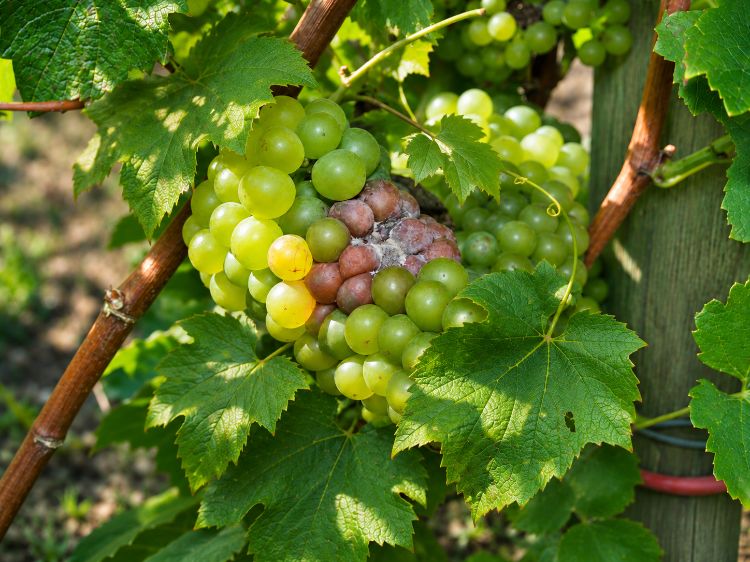
During ripening, downy mildew can reduce effective photosynthetic leaf area if lesions and defoliation become substantial. This may constrain sugar import and the replenishment of reserves, especially when crop demand is high. Late-season cluster rots create a separate, direct threat to fruit integrity. September scouting documented sour rot and other rot concerns, as well as bird injury, while cooler and humid conditions complicated the balance between additional hang time and deterioration. Southeast Michigan likewise progressed into harvest earlier than northern regions, with early ripening hybrids harvested by September.
Northwest Michigan: Evidence of advancing vinifera maturity
In northwest Michigan, the climatic influence of Lake Michigan and the relatively short ripening season produce a different set of constraints. On Aug. 26, Pinot Noir on the Old Mission Peninsula was reported at approximately 40% veraison while Cabernet Franc and Merlot were beginning veraison. Gewürztraminer and Chardonnay were relatively advanced among white cultivars; Riesling was developing more slowly.
The Sept. 23 MSU Extension measurements indicate different degrees of maturity among monitored cultivars. Gewürztraminer averaged 20.1 Brix with a juice pH of 3.11, while Chardonnay reached 19.8 Brix at pH 3.11. Pinot Gris was similar in soluble solids (19.7 Brix), but had a lower pH of 3.01. These white cultivars were thus close to 20 Brix in the reported sample set, suggesting substantial progress toward the sugar levels appropriate for a range of cool-climate still-wine styles. Their pH values also indicate relatively acidic juice, but pH alone does not establish whether the fruit had an appropriate titratable acidity or acid balance.
Among red cultivars, Pinot Noir measured 19 Brix and pH 3.0 while Merlot reached 18.5 Brix and Cabernet Franc 17.0 Brix. Riesling was at 16.8 Brix. These differences are biologically meaningful: They are consistent with differences in phenology, cultivar ripening requirements and possibly crop load or vineyard position, but the scouting observations do not isolate the causes. The readings should not be treated as representative statewide cultivar means or final harvest-lot compositions.
The interpretation also depends on intended wine style. Pinot Noir near 19 Brix could be compatible with some sparkling-wine objectives while production of a more structured still red wine would require additional assessments of sugars, acidity, flavor and phenolics. Riesling at 16.8 Brix might still be suitable for certain styles if sensory development, acidity and sanitary condition are favorable. Cabernet Franc at 17.0 Brix would warrant continued monitoring where the goal is a fully ripe still red wine, subject to disease and weather risks. None of these data, in isolation, establish superior or inferior finished-wine quality.
Does a 14-day rise in Brix prove accelerated sugar import?
Comparing the Sept. 9 and Sept. 23 scouting results provides a more quantitative picture of the observed ripening progression. Chardonnay rose from 15.2 to 19.8 Brix, a difference of 4.6 Brix over 14 days. Pinot Noir increased from 13.7 to 18.9 Brix, and Pinot Gris from 14.5 to 19.7 Brix; both changes were 5.2 Brix. Merlot showed the largest numerical difference, from 12.8 to 18.6 Brix (+5.8), followed by Cabernet Franc from 12 to 17 Brix (+5). Riesling increased from 12.6 to 16.8 Brix (+4.2).
Across these six reported comparisons, the change ranged from 4.2 to 5.8 Brix. This is consistent with substantial progression in soluble-solids concentration during the first three weeks of September.
These figures should not be converted into cultivar-specific physiological sugar-import rates. The two reports are regional monitoring snapshots, not a controlled longitudinal experiment tracking identical vines and clusters. A difference of 5.8 Brix for Merlot, for example, does not prove that Merlot accumulated more sugar per berry than Chardonnay or Riesling. Soluble solids are expressed as a concentration; their increase may result from continued phloem sugar import, changes in berry water content, or both.
Quantifying net sugar accumulation requires berry mass and sugar-per-berry data, ideally with standardized repeat sampling. Similarly, a favorable rise in Brix cannot confirm phenolic maturity or stable fruit health. The appropriate interpretation is that monitored fruit became markedly more concentrated in soluble solids over this interval, offering an opportunity for further maturity where sanitary conditions permitted.
Tip of the Mitt: Cold-hardy hybrids and ripening reliability
The cooler Tip of the Mitt AVA provides a useful contrast with northwest Michigan’s vinifera-dominated sites. By Sept. 23, harvest had begun for early-season hybrids such as Itasca and La Crescent, while other cultivars remained in the final stages of ripening. MSU Extension reported that Itasca had reached 22.5 Brix at pH 2.96, the highest soluble-solids value in the listed monitoring samples. Marquette reached 21 Brix at pH 2.94, and La Crescent reached 20.8 Brix at pH 2.95.
The accumulation of approximately 21–22.5 Brix in these cold-adapted cultivars, despite markedly lower regional GDD totals than southwest Michigan, illustrates their potential to reach harvest-relevant sugar concentrations within a relatively short growing season.
Other reported samples demonstrated that hybrid fruit chemistry was not uniform. L’Acadie Blanc reached 21 Brix with a higher pH of 3.15 whereas Frontenac Gris measured 18.5 Brix and pH 2.88. In the same regional report, Zweigelt measured 19 Brix and Riesling 17.2 Brix; pH data were not reported for these two cultivars. These observations suggest differing ripening trajectories and acid–base characteristics, but the limited monitoring data do not establish their underlying causes or the sensory quality of the resulting wines.
The particularly low pH values observed in Itasca, Marquette, La Crescent and Frontenac Gris highlight a practical enological issue. Low juice pH may support microbial stability and preserve freshness, but does not indicate titratable acidity, malic acid concentration or perceived sourness on its own. Indeed, pH and titratable acidity represent different chemical properties, and wines from high-acid hybrids may require distinctive harvest and winemaking decisions. Without corresponding measures of titratable acidity, organic-acid composition and sensory development, it would be premature to call these lots either optimally balanced or excessively acidic. The numerical results are regional monitoring observations, not final harvest chemistry for the entire AVA.
The comparison between vinifera and hybrids must therefore distinguish two different attributes. Cold hardiness concerns survival under low temperatures, whereas earliness concerns the timing of development and maturity. A cultivar can be extremely cold hardy in midwinter yet vulnerable to spring frost because it breaks bud early. Likewise, an early-ripening hybrid may reach a desirable harvest composition in a cool region without necessarily producing a wine of higher quality than a later-ripening vinifera cultivar grown on a suitable site.
Disease, canopy microclimate and functional leaf area
The 2026 scouting reports documented regionally variable pressure from downy mildew, powdery mildew, black rot and cluster rots. Their effects should be differentiated. Foliar disease may limit carbon assimilation and accelerate leaf senescence, particularly if infection is severe. Cluster disease directly compromises fruit integrity and can alter the microbial and chemical condition of the harvested lot.
The consequences for wine depend on infection severity, sorting, transport and winery processing. Canopy architecture establishes the importance of intercepted radiation, canopy density and cluster-zone microclimate in regulating vine performance. This principle is relevant to a season characterized by early moisture, vigorous growth in some sites, and localized disease pressure. Shoot positioning, timely hedging, and selective fruit-zone leaf removal can improve airflow, light distribution, and spray penetration. Yet excessive leaf removal can reduce canopy photosynthesis or increase berry exposure to high temperature and solar radiation.
These tradeoffs are especially important in frost-damaged vines, where the amount and distribution of replacement leaf area may differ from those of unaffected vines. Vineyard operations should therefore be adjusted according to canopy function and fruit exposure, not implemented solely to achieve a visually open canopy.
What can be concluded about the quality of the 2026 vintage?
Grape maturity, fruit quality and finished-wine quality are related but distinct outcomes. Soluble solids describe concentration of dissolved constituents, predominantly sugars; pH reflects hydrogen-ion activity and buffering; titratable acidity estimates total titratable acid equivalents. Flavor precursors, berry integrity, phenolic composition, malic acid and the timing of harvest add further dimensions. Red wine potential also depends on tannin and anthocyanin development, whereas white and sparkling wine objectives may place greater emphasis on acidity, aromatic expression and freshness.
Peynaud's contribution to scientific enology emphasized integrating chemical analysis with disciplined sensory assessment. Accordingly, the monitored September values should be interpreted as evidence of ripening status and quality potential, not as a validated vintage score. The available reports do not include a representative statewide harvest database linking yield, maturity, disease incidence, juice chemistry and finished-wine sensory quality. Grower optimism is valuable contextual evidence, but it cannot substitute for those measurements.
The observations nevertheless support a cautiously positive assessment for certain vineyard–cultivar combinations. Several northwest Michigan vinifera cultivars showed appreciable soluble-solids accumulation by late September; multiple Tip of the Mitt hybrids approached or reached harvest-relevant concentrations; and some southern vineyards proceeded with harvest despite frost and disease challenges. They also demonstrate that the season was heterogeneous. Consequently, it would be scientifically premature to designate 2026 as uniformly excellent, poor or exceptional across Michigan.
Implications for Michigan growers and the 2027 season
The most useful outcome of a vintage assessment is not a simple ranking but a set of testable management lessons. The 2026 season reinforces the importance of documenting spring injury by cultivar, block, topographic position, and phenological stage. When primary shoots are damaged, growers should estimate secondary shoot contribution and track its consequences for crop level and ripening uniformity rather than assuming lower yields will improve quality.
Representative sampling should begin early enough to establish a ripening trajectory and repeated on consistent blocks and sampling protocols. In addition to Brix and pH, collect titratable acidity, berry mass and, where feasible, malic acid concentration. For red grapes, include appropriate assessments of color and phenolic maturity; for diseased or damaged fruit, record incidence and severity separately from fruit chemistry. Whenever possible, link these measurements to actual yield per vine or per block and to subsequent winemaking outcomes.
Canopy and crop-load management should aim to maintain adequate functional leaf area, control unfavorable fruit-zone humidity, and limit undue shading without increasing heat or sunburn risk. Harvest decisions should integrate intended wine style, short-term weather risk, fruit integrity, and expected benefits of further ripening. In years with pronounced seasonal variability, records of vineyard decisions are essential for distinguishing the effects of weather from those of management.
Michigan’s 2026 growing season was characterized by localized but severe spring freeze injury, differing recovery trajectories, contrasting regional thermal conditions and uneven disease pressure. In some southern vineyards, primary-shoot loss and later secondary bloom altered crop development. In northern Michigan, September monitoring documented encouraging soluble-solids concentrations in selected vinifera cultivars and several cold-hardy hybrids. These observations demonstrate meaningful quality potential in favorable sites, but they do not establish statewide finished-wine quality.
The scientific lesson is that environmental events do not act on yield and fruit chemistry independently. Frost can modify both crop demand and assimilatory supply; canopy development and disease determine the persistence of functional leaf area; and cultivar phenology determines whether the available season can support the desired ripening trajectory. Quality-oriented viticulture depends on the interaction between the environment, the cultivar, and human decisions.
The most defensible assessment of the 2026 vintage is therefore regionally differentiated and cautiously optimistic, pending final harvest composition and wine-level evaluation.

