


Lake Michigan School Food System Innovation Hub Launches Spark Award Grant Opportunity to Reimagine School Meals
 Print
 Email
Application opened on October 30; interested Michigan grant applicants can apply by January 22, 2027
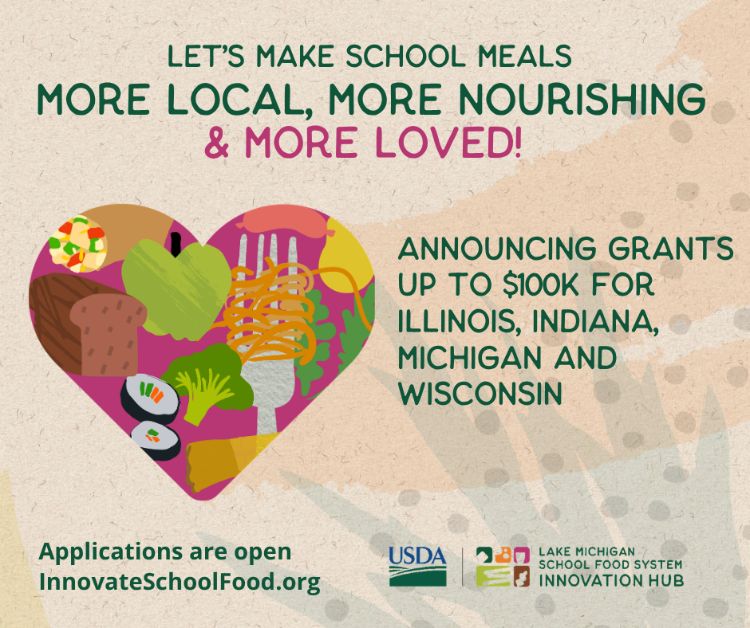
The Lake Michigan School Food System Innovation Hub (Innovation Hub ) opened a new funding opportunity for collaborations of local food system leaders who want to ensure that school meals better reflect the Lake Michigan region’s rich traditions and abundant harvests. Grant applications opened on October 30 and are due on January 22, 2027. To announce the Spark Awards, the Innovation Hub hosted a kick-off introductory webinar on November 4.
“We’re looking forward to see people across Michigan — from farmers and food suppliers to school food service directors and community-based program leaders — come together to help the food that kids eat at school be more local, more nourishing, and more loved,” said Julie Lehman, Farm to Youth Network Coordinator with Michigan State University Center for Regional Food Systems, a leading member of the Innovation Hub. “Project teams from our first cohorts of grantees are already expanding innovation throughout our state, and we can’t wait for more teams to fuel more meaningful change.”
In Michigan, more than 865,000 students eat school food every day. Following the previous two rounds of Innovation Hub funding, the Innovation Hub will offer new grants up to $100,000 to build pathways for local, nourishing food to reach more of the region’s K–12 schools. The Innovation Hub seeks applicants who have fresh ideas to strengthen the local school food system and want to collaborate with community partners to bring those ideas to life. This round represents the final opportunity in the current funding cycle for organizations to apply for Spark Award funding.
“The Illinois Public Health Institute is proud to continue to support leaders in Illinois, Indiana, Michigan, and Wisconsin as they develop practical, locally driven solutions to improve school meal programs,” said Crystal Pirtle Tyler, CEO of IPHI, which convenes the Lake Michigan School Food System Innovation Hub. “These projects will help strengthen our local agriculture, boost regional economies and ensure schools have access to food that reflects their preferences.”
Grants will be available to teams that may be composed of farmers, food suppliers, food industry partners, schools and school districts, community-based program leaders and more.
The Lake Michigan School Food System Innovation Hub is a United States Department of Agriculture (USDA), Food and Nutrition Administration–funded grant-making initiative that reimagines students’ meals. With support from the USDA Food and Nutrition Administration’s Healthy Meals Incentives (HMI) Initiative, the Innovation Hub offers funding, training and other assistance to partnerships that include farmers, food producers, suppliers, distributors, schools and organizations. The Innovation Hub invests in community-driven ideas of all sizes and scopes—from hyper-local projects to multistate collaborations—as long as projects direct more resources to students, schools and local economies. More information about eligibility requirements can be found at InnovateSchoolFood.org.
For more information, contact Jazmin Bolan-Williamson, Food and Farm Business Coordinator with Michigan State University Center for Regional Food Systems bolanwil@msu.edu you can also schedule a meeting using the calendly link: Jazmin- Calendly or visit InnovateSchoolFood.org.
Join Open Office Hours:
- Tuesdays, 10:30 – 11:30 am ET (Julie Lehman)
Zoom link: https://msu.zoom.us/j/5658155119 Meeting ID: 565 815 5119 Passcode: lovelocal
- Wednesdays, 12:00 - 1:00 pm ET (May Tsupros)
Zoom Link: https://msu.zoom.us/j/8734970127 Meeting ID: 873 497 0127
The Michigan State University Center for Regional Food Systems advances regionally-rooted food systems through applied research, education, and outreach. We do this by uniting the knowledge and experience of diverse stakeholders with that of MSU faculty and staff. Our work fosters a thriving economy, equity, and sustainability for Michigan, the nation, and the planet by advancing systems that produce food that is healthy, green, fair, and affordable. Learn more: foodsystems.msu.eduAbout Michigan State University Center for Regional Food Systems