Identifying Solutions and National Themes: Regional Farm to Institution Networks Network!
 Print
Print Email
EmailFarm to institution networks create a space for groups of different types of organizations to gather, brainstorm, and align towards solutions. In 2026, members of these networks from across the country connected to brainstorm solutions.
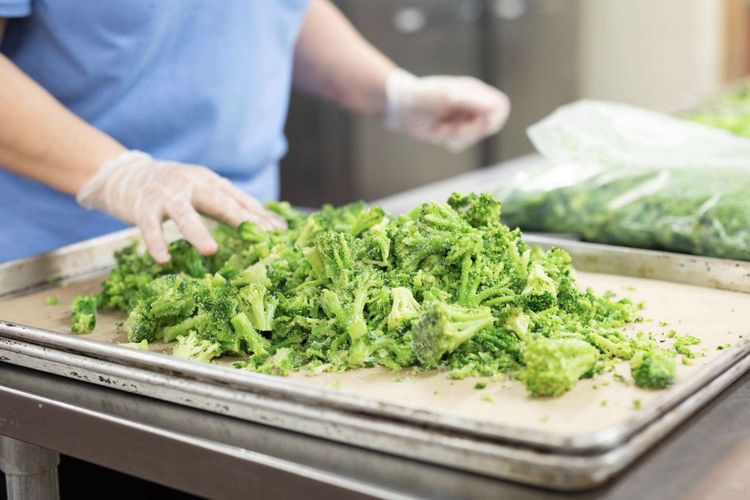
Farm to institution networks are not a new concept. These networks have been around for several decades and can be seen in national and regional examples like National Farm to School Network (NFSN) and Farm to Institution New England (FINE). At the basic level, “Farm to Institution” work has meant a focus on procuring locally sourced food for dining programs in institutional spaces. More recently, “local” has expanded to often encompass other good food purchasing values, such as environmental sustainability, valued workforce, and community nutrition, as presented by the Center for Good Food Purchasing.
Farm to institution networks create a space for groups of different types of organizations to gather, brainstorm, and align towards solutions. Farm to institution networks are multi-faceted and often have different goals and stakeholders based on the focus area – K-12 schools, Early Care and Education, universities, hospitals, prisons, etc. Generally though, networks act as the connective tissue between the folks on the ground doing the work: they bring together farmers, food service directors, educators, state-agencies, non-profit partners and more. They become spaces to learn, listen, try new things, innovate, collaborate, and reach across sectors to build a stronger local and value-focused food system in whatever geographic location is the focus. In the dynamic landscape that is “Food Systems” work, farm to institution networks act as a vessel for creative solutions for positive change to take root and grow.
National Farm to Institution Network Connecting Points
In 2026, Aliza McHugh of Oregon Farm to Institution Collaborative (OFIC), Dara Bloom of the emerging North Carolina Farm to Institution Network, and May Tsupros of the Michigan Farm to Institution Network, who serendipitously met through shared space and conference going, started connecting in the spirit of collaboration and began asking some big questions: How do we fund these networks? How do we ensure these networks are meaningful and driving towards collaborative goals? How do we showcase our impact? And most importantly, how do we support each other to do this work more effectively and efficiently in order to create systems-level change?
Inspired by these questions, Aliza, Dara, and May wanted to bring in more perspectives to interrogate how national alignment could build more robust and sustainable state-level networks and systems. In March 2026, they began hosting virtual National Farm to Institution Network Connecting Point meetings to create a space for other leaders from across the country to join the conversation. These meetings allowed participants to identify common sticking points across different geographic regions, and collectively discuss where there may be leverage points to dismantle silos and step into authentic collaboration.
Fourteen other leaders who coordinate 11 different state-level Farm to Institution networks met during three “think tank” style meetings. Hosted in March, April and May 2026, the 90-minute meetings spanned topics and questions that frequently came up for the three facilitator participants, and were influenced by baseline data that was collected from participants in a pre-meeting survey. While the meeting themes were mapped out in advance, there was room for emergent ideas and conversation:
- Meeting 1 focused on mapping the landscape, reviewing an initial survey of the leader’s networks, and discussing why states formed networks and what their perceived value was.
- Meeting 2 discussed shared barriers with the group, identifying cross-cutting themes that networks were facing.
- Meeting 3 discussed naming power dynamics based on barriers and potential solutions that could move shared visions forward.
National Themes and Identifying Solutions
Throughout these meetings, the original set of questions were kept top of mind and were explored by examining each other's work and understanding each state’s unique differences. Intention was put to separating out concrete issues to address, and those that felt systemic, and therefore might take more coordination. For example, participants were encouraged to distinguish between challenges, which were defined as difficult tasks or problems that can be overcome with effort, strategy, or skill, often serving as opportunities for growth; and barriers, meaning significant obstacles, constraints, or boundary conditions that directly prevent, block, or hinder progress and are often outside immediate control. Meetings were documented and participants were generous with their time to dig deeper into possible solutions to challenges and barriers. The list is extensive, but some top strategies that could be pursued together were:
- Building a coordinated national pitch and increasing the awareness of farm to institution with shared metrics that could demonstrate collective impact around values-based procurement solutions
- Funding policy work that would seek to expand farm to school and ECE incentive programs in state-level budgets, giving insights to incentive programs for other institutions
- Pursuing collective, coalition-based farm to institution policy proposals rather than single-state efforts
- Building shared storytelling/resources that make the impact of institutional purchasing tangible
- Exploring Medicaid and other health-system dollars and funding pathways into integrating Food as Medicine and Farm to Institution
Collaborating across multiple states to create national alignment takes effort but it’s worth it to explore long term, rather than short term solutions. There are states with committed individuals and groups who are poised to invest the time and resources into developing shared goals, including funding, evaluation, program implementation and more to be able to articulate collective impact and mobilize to create a shared agenda for moving forward. This group is currently compiling an in-depth collection of the data, conversations, and recommendations that were collected during the three “connecting point” meetings in March, April, and May 2026; check back soon to read the full report and set of recommendations.
If you are interested in learning more and sharing your story, please contact May Tsupros (tsupros1@msu.edu), Dara Bloom (jdbloom@ncsu.edu), and/or Aliza McHugh (ofic-coordiantor@ocfsn.org) to join the mighty group of folks rolling this work forward.
About Michigan Farm to Institution Network
The Michigan Farm to Institution Network (MFIN) helps people across the farm to institution supply chain learn, connect, and collaborate. Since 2014, we have provided a space for learning, sharing, and working together to help farm to institution programs grow in Michigan. Learn more: mifarmtoinstitution.org
About Michigan State University Center for Regional Food Systems
The Michigan State University Center for Regional Food Systems advances regionally-rooted food systems through applied research, education, and outreach. We do this by uniting the knowledge and experience of diverse stakeholders with that of MSU faculty and staff. Our work fosters a thriving economy, equity, and sustainability for Michigan, the nation, and the planet by advancing systems that produce food that is healthy, green, fair, and affordable. Learn more: foodsystems.msu.edu