Health insurance as a farm business decision
 Print
 Email
Estimating farm household income and exploring healthcare coverage options.
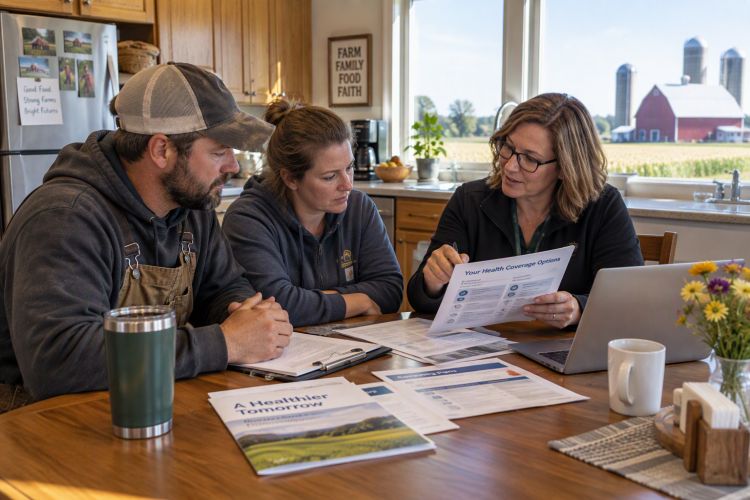
By estimating household income and exploring health insurance options, farm families may identify opportunities to align health coverage, family goals and farm business growth.
For generations, many farm families have relied on off-farm employment to obtain health insurance. In fact, it is common to hear a farmer say, “I keep my job for the benefits.” The USDA Economic Research Service published results from a 2015 survey showing that 55% of farm households have an operator or spouse employed off the farm, and employment-based insurance remains their primary source of coverage. While employer-sponsored health insurance remains a valuable option, today’s Health Insurance Marketplace offers many farm families another path to explore.
The decision to take or keep an off-farm job should not be based solely on access to health insurance. It should also consider the impact on farm profitability, family goals, labor availability and quality of life. For some farm families, Marketplace coverage may help them maintain health insurance while dedicating more time and energy to the farm business. Marketplace Open Enrollment for 2027 runs from November 1, 2026 to January 15, 2027 on HealthCare.gov, with January 15 as the federal final deadline and December 15, 2026 as the cutoff for January 1, 2027 coverage.
Looking beyond the insurance premium
When evaluating health insurance options, many people focus on monthly premiums. However, farmers should also consider the opportunity cost of working off the farm.
An off-farm job may provide health insurance, but it also requires time. Those hours spent commuting and working elsewhere are hours that cannot be spent:
- Expanding production
- Improving marketing efforts
- Keeping better records
- Pursuing value-added opportunities
- Developing new enterprises
- Improving farm management practices
- Spending time with family
A farmer working 20 hours per week off the farm primarily for benefits is giving up more than 1,000 hours per year that could potentially be invested back into the farm business.
Marketplace coverage and estimating income
Many farmers assume that purchasing individual health insurance is too expensive. However, Marketplace plans may offer premium tax credits that reduce monthly costs for eligible households. For 2027 Marketplace coverage, a KFF publication dated October 28, 2026 reported that premium tax credits are generally limited to households with income at or below 400% of the Federal Poverty Level. At the same time, insurers are proposing a median 15% premium increase for 2027 Marketplace plans, increasing affordability concerns for many farm families.
The best way to find out if you qualify is to estimate your household income and compare the plans available through the Marketplace. According to the Internal Revenue Service, Marketplace subsidies are based on the income you expect to earn during the year, but the final amount is calculated when you file your taxes using Form 8962. If you earn more income than you estimated, you may have to pay back some or all of the subsidy you received. Beginning with the 2026 tax year, there is less protection for people who underestimate their income, making accurate farm records more important than ever.
For help exploring your options, visit http://www.healthcare.gov or contact a licensed insurance agent. If you work with an agent, ask whether they have experience helping farm families. It is also a good idea to work with your tax preparer or accountant to estimate your farm household income as accurately as possible before enrolling in a Marketplace plan.
A farm business planning opportunity
Farmers routinely make management decisions by analyzing costs and benefits. Health insurance decisions deserve the same approach. Rather than asking, "Can I afford health insurance without an off-farm job?" Consider asking: "What could my farm earn if I redirected the time spent working off the farm back into the business?"
For example, a vegetable producer might use additional time to:
- Add another farmers market
- Expand a CSA program
- Increase direct-to-consumer sales
A livestock producer might:
- Improve grazing management
- Expand herd size
- Develop direct meat marketing channels
The value of these opportunities may exceed the cost difference between employer-sponsored insurance and other health insurance coverage.
Quality of life matters too
Not every benefit can be measured in dollars. Reducing off-farm employment may allow farm families to:
- Spend more time together
- Attend children's activities
- Reduce commuting stress
- Increase flexibility during planting and harvest
- Improve work-life balance
For many farm families, these outcomes are just as important as financial considerations.
Questions every farm family should ask
Before accepting or keeping an off-farm job primarily for health insurance, consider:
- How many hours per week are devoted to off-farm employment?
- What is the true value of those hours to the farm business?
- Have we explored Marketplace coverage options?
- Have we estimated our household income accurately?
- Could additional time on the farm increase profitability or improve family goals?
- Are we keeping the job because it still makes financial sense, or simply because we have always done it that way?
The bottom line
Health insurance is not just a health care decision. It is also a labor, business, and family decision. For some farm families, an off-farm job with benefits remains the best choice. For others, Marketplace coverage may offer an affordable alternative that allows more time to be invested in the farm business and family priorities.
The key is not to assume one option is better than the other. Instead, farmers should evaluate all options carefully and annually by estimating household income, comparing available coverage and determining which choice best supports their goals.
Exploring healthcare insurance options may reveal opportunities that allow a farm family to spend less time working for benefits and more time building the future of their farm.