Grazing lambs: Key considerations for successful weaning onto grain-based diets
 Print
 Email
Lamb health and performance can be improved with effective weaning strategies off pasture and into the feedlot.
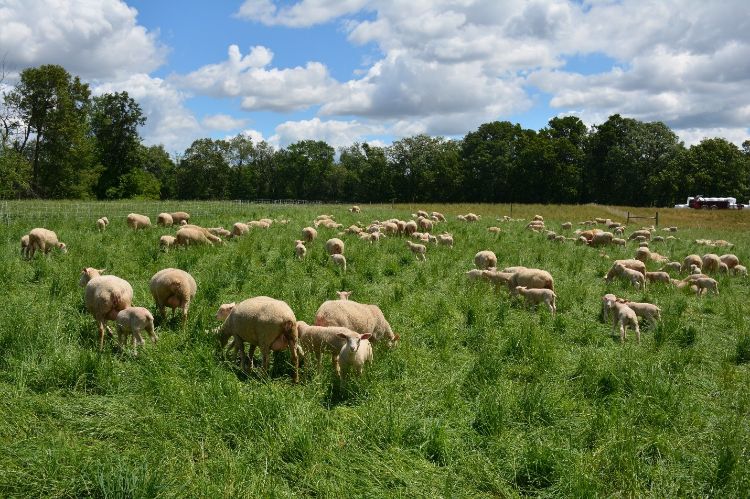
Strong and steady lamb prices create an even stronger incentive to optimize weaning strategies for lambs born and/or raised on pasture. Setbacks at weaning can add weeks to lamb finishing programs and compromise health, adding additional cost and jeopardizing welfare. This article will outline major issues to consider in optimizing weaning programs for lambs born and/or raised on pasture and then raised on grain-based diets following weaning.
Age at weaning
The decision of when to wean lambs raised on pasture is based on several factors, including:
- Quality and quantity of pasture forage supply
- Parasite contamination level of pasture forage
- Necessity to add body condition to ewes before rebreeding
Producers with small inventories of quality, low parasite-contaminated forage are best advised to wean earlier than those who have lots of clean pastures. Maintaining lambs on highly contaminated pastures is counterproductive, and it would be best to wean these lambs and place them in a feeding program if clean grazing options (hay field regrowth or annual crops such as forage turnips, rape, chicory, etc.) are not available. Dry ewes can continue to graze parasite-contaminated areas with far fewer issues than lambs. Weaning grazing lambs earlier than 45 days of age is not advised, as these lambs will suffer large growth setbacks, whereas 60-day-old lambs are much more capable of making a relatively seamless weaning transition.
Ewes will regain condition quickly following weaning since the high requirements of milk production will be gone, and the ewe can redirect these nutrients to replenish lost body reserves. It is important to replenish these reserves prior to breeding to optimize ovulation rate for the next lamb crop. In my accelerated lambing flock, I wean lambs from lactating ewes on pasture three weeks before the next breeding season in order to allow time for ewes to replenish body condition. A two-three week period is the minimal time needed if pasture alone is used to replenish condition. Annual lambing programs will have a much more forgiving time frame to replenish condition but still should not ignore this need.
Annual lambing programs with large inventories of relatively clean grazing ground may find it more economical to delay weaning until lambs are over 90 days of age. In summary, the decision of when to wean pasture-raised lambs should be based on the relative availability of clean grazing ground and the need to replenish maternal body condition prior to breeding.
Nutrition program
Abrupt dietary changes are to be avoided at weaning. Obviously, this is hard to do when weaning lambs off grass and transitioning them to a grain-based finishing program. There are, however, strategies available to ease this transition which cover three main areas:
- Allowing lambs to learn about grain consumption from their moms in the final weeks leading up to weaning
- Formulating diets that are high in fermentable fiber during the initial transition phase
- Allowing adequate time (7-14 days) to transition from a forage to grain-based diet
Strategy #1, the learning phase, can be done simply by feeding a mix of whole and/or relatively unprocessed grains on the ground in the 7-10 day period leading up to weaning. MSU Extension recommends feeding one-half lb. of grain per ewe in long thin rows on short grass, which will allow lambs to pick up some of the grain and learn this feeding behavior from their moms. This training program can be done every other day or so in the final week prior to weaning. Lambs that learn about grain consumption from moms and other lambs retain this knowledge at weaning and will seek grain in feeders on the first day of weaning more quickly than those without previous exposure. This also minimizes problems of variable grain intake commonly encountered during the early weaning phase. Variable grain intake occurs when some lambs learn more quickly than others. The quick learners eat too much and get sick (acidosis or worse), whereas the slow learners don’t receive adequate nutrition. Schooling lambs in the pre-weaning period is a way to minimize this problem.
Another important strategy (#2) is to provide a safe grain diet in the transition period so that lambs do not consume excessive starch before their gastrointestinal tract is adequately adapted to handle a high starch diet. This can be done by substituting energy in the form of highly fermentable non-forage fiber (soy hull feed/pellets) over cereal grains that are high in starch (corn or barley). An example diet might contain an equal proportion of corn and soy hull pellets. This would allow lambs to be exposed to starch while maintaining the safety of a highly fermentable, high-energy feed (soy hulls). Pasture-raised lambs that are allowed sudden, unlimited access to soy hull pellets would likely have only mild digestive disturbance, whereas those allowed sudden, unlimited access to corn or barley could easily die from enterotoxemia (overeating disease) and almost certainly would develop massive digestive disturbance and metabolic acidosis.
Soy hulls, either in loose or pelletized form, have a fiber component similar to highly digestible quality forage; therefore, lambs can make a more seamless transition to this energy source than they can to high starch energy sources (corn and barley). Many producers have found that maintaining a soy hull component in lamb diets (15-25% of diet dry matter) following the transition period is also beneficial in minimizing metabolic issues of lambs on full feed (high-grain ration). The exact proportion in a finishing diet might be best chosen based on the commodity prices of soy hulls vs. corn or barley. The feed-to-gain ratio (feed: gain) will be slightly higher in a soy hull-based diet, but the rate of gain will scarcely be impacted. Overall, the costs incurred by the higher feed: gain ratio will likely be offset by the reduced incidence of metabolic disturbances.
The final nutritional strategy (#3) is to provide adequate time for diet transition. In practice, it works well to provide unlimited access to hay during the early weaning period of a type and quality that is very similar to the pasture they had been consuming. It is very important to stimulate feed intake during this period, so providing forage that they are familiar with is especially helpful. An effective strategy is to take lambs directly off pasture and start them on a high percentage soy hull diet (70-75% soy hulls) offered free choice along with free choice quality hay. This transition can be done by filling self-feeders with a diet that is 60% soy hull feed and 40% of the transition diet (which should contain 20-30% soy hulls already, so the composition of this mix would be approximately 70-75% soy hulls) on day 1 and then gradually “pulling out” the added soy hull fraction over a 7-10 day period. In this way, the lambs are only eating the transition diet, which contains 20-30% soy hulls, at the end of the 7-10 day period. Transition periods to higher starch-based feeds should be slower (up to 3 weeks).
It is important to monitor lambs closely during the transition period. The transition may need to slow down (less grain) if the incidence of diarrhea is too high (>10% of lambs). Adjustments to the speed of the diet transition program may need to be made along the way. Mild diarrhea is hard to avoid, as the rate of passage of feed through the lamb’s body will be increasing as they consume a greater proportion of grain in their diet. But severe diarrhea is a clear sign to slow down. It is sometimes difficult to distinguish between nutritional scours and scours due to coccidiosis during the early weaning period, so a program for coccidiosis control at this time is important (as explained next).
Health program
The stress of weaning creates a very vulnerable time in the life of the lamb, which makes lambs very susceptible to coccidiosis and other stomach and intestinal parasites. The immune system of the lamb is compromised at weaning, which provides an opportunity for parasites to thrive. Accordingly, preventative and treatment measures are advised. Lambs weaned off pasture into the feedlot are notoriously susceptible to coccidiosis. Coccidiosis outbreaks can be controlled in these lambs by treatment with amprolium or sulfa drugs, which can be administered by drench, in feed, or in drinking water. Administering these treatments in grain is a poor idea because grain consumption at this time is low and variable. Amprolium is the product of choice for treatment if administered in drinking water, as it does not create a bitter taste like sulfa drugs. Sulfa drugs have the advantage of also controlling certain respiratory diseases, but I would advise against sulfa treatments in drinking water because it is important to maximize water intake during the transition period. Consult with a veterinarian on the use of either sulfa drugs or amprolium, since their use in sheep is off-label. Coccidiostats should also be fed in grain diets during this period to prevent major outbreaks. Decoquinate (Deccox) included in the total diet at 13.6 gal./ton provides effective coccidiosis control. Coccidiostats are helpful, but care should be taken to provide adequate dry bedding, clean feeders and waterers as part of a comprehensive prevention program.
It is also very important to treat newly weaned lambs raised on pasture with anthelmintics at weaning to minimize parasite outbreaks. Even at relatively low levels of infection, the stress of weaning can advance these infections quickly even when lambs are weaned into a dry lot. All deworming treatments should be part of a whole farm parasitic management plan that seeks to maintain a refugia population of parasites that are less exposed to drugs. However, weaned lambs are not a good population for this refugia as they are less immunologically robust against parasites. Therefore, it is best to treat all weaned lambs raised on contaminated pastures at weaning and use a less susceptible population for refugia (such as dry ewes).
A combination drug treatment program is the best drug treatment approach as it assures the best efficacy and minimizes build-up of larvae resistance to a single class of drugs. Drugs chosen for combination therapy should represent different chemical classes. In the USA, there are approved drugs for sheep in the macrocyclic lactone family (moxidectin (Cydectin) is generally the most effective in this class), one in the benzimidazole family (many members; only albendazole (Valbazen) is approved for sheep) and one in the imidazothiazole family (levamisole, or Prohibit). When applied correctly, this combination approach is highly effective and will eliminate gastrointestinal nematodes and tapeworms.
Vaccination of lambs against Clostridium perfringens types C and D is advised for lambs weaned off pasture and onto grain. It is thought that these lambs are particularly susceptible to enterotoxemia (overeating disease) because they have not consumed much starch in their diets and therefore have had little exposure to the toxins produced by the disease organism (which thrives on starch in the intestines). Low-level exposure of lambs to the deadly toxin is thought to confer some resistance. Effective antibody titers (blood concentration) will not exist until after the second booster injection (best to give booster two weeks following primary immunization), so even vaccinated lambs will experience a period of vulnerability, particularly if their mothers were not vaccinated. Therefore, to minimize this period of vulnerability, the most effective preventative measure is ensuring that ewes are vaccinated 2-3 weeks prior to lambing, providing passive immunity to their lambs via colostrum consumption until weaning, when active immunity can be established with vaccination.
Adequate ventilation is also very important to newly weaned lambs. They are prone to respiratory disease, so adequate air exchange is an important preventative measure. Good ventilation will also help to dry the bedding and minimize the potential for coccidiosis outbreaks. Other facility considerations include waterers and feeders. It is critical that newly-weaned lambs consume lots of water at weaning, so it is best to provide the same type of watering troughs/tubs/tanks indoors as they had experienced on pasture for the first few days until they learn about the new indoor water sources. Since this protocol involves unlimited access to grain, less feeder space is needed than if lambs were limit-fed; however, providing a minimum of two inches of bunk space per weaned lamb is advised as reported in the Midwest Plan Service, Sheep Housing and Equipment Handbook, MWPS-3, Iowa State University published in 1994.
Finally, care should be taken to avoid stressful handling and movement of newly weaned lambs. Treat lambs calmly and gently at feeding and avoid disturbances. These lambs are accustomed to a pasture environment, and care should be taken to minimize stress as they adapt to an entirely new environment. Paying attention to the issues discussed here, such as transitioning slowly onto a highly digestible fiber diet, using coccidiostats, controlling parasites, vaccinating dams for Clostridium perfringens types C and D, providing adequate ventilation and ample feed and water access will allow your lambs to make a fast and safe transition during a stressful period.