


Buy now or wait? Best practices for securing next year’s farm inputs
 Print
Print Email
EmailWhat recent fertilizer and crop prices can teach us about buying farm inputs.
As the months turn from late summer into fall, many farms start to look ahead to not only harvest but also purchasing next year’s farm inputs. A common question asked is: Are farm input prices better now, or should you wait to make a purchase until spring?
Answering that question presents quite a challenge. Historically, farms that prioritize purchasing inputs early tend to have lower total input costs. Deciding when the right time is to purchase inputs for your farm requires thinking strategically about your buying options. When we consider commodity prices, input purchases are sometimes better to make in the spring.
Understanding market conditions
Understanding market conditions is essential when buying farm inputs. Markets are influenced by a number of different factors, such as supply chains and commodity prices.
Declines in commodity prices and concerns of eroding farm profits often create pressure to lower input costs. This can lead to higher demand for farm inputs in the short term. If demand is strong enough, it may make waiting to buy inputs a better option.
Long-term commodity projections lean towards lower or steady prices unless production estimates significantly change. A significant change can be brought on by domestic events such as poor weather or drought. Production estimates can also change due to global events such as wars and foreign trade issues.
When uncertainty exists in the markets, explore other options to assist decision-making. For fertilizer purchases, a fertilizer-to-crop price ratio helps consider short-term profits compared to product use. A higher price ratio – the higher the number – indicates a more expensive fertilizer compared to the intended crop’s value.
To calculate this ratio, first you need to calculate the price per pound of the fertilizer. For example, consider Diammonium Phosphate (DAP) or 18-46-0 contains 46% or 920 pounds of phosphorus in one ton of product. If DAP is priced at $877 per ton, dividing the price per ton by 920 pounds results in a price per pound of $0.95 ($877 divided by 920). To then calculate a fertilizer to crop price ratio, divide $0.95 per pound by the price per bushel of the intended commodity. If DAP is used on corn priced at $4.47 per bushel, the fertilizer-to-crop price ratio would be 0.25 ($0.95 divided by $4.47).
Figures 1 and 2 illustrate fertilizer-to-crop price ratios over the past five seasons for phosphorus and potassium, respectively.
In Figure 1, phosphorus fertilizer prices are compared to three crops: corn, soybeans and wheat. For all crops, the fertilizer-to-crop price ratio indicates that phosphorus fertilizers were less expensive in the fall of 2023 compared to the following spring. The fall of 2024 was also less expensive than the following spring for wheat. In all remaining years, the spring sales period has offered a better price for phosphorus purchases.
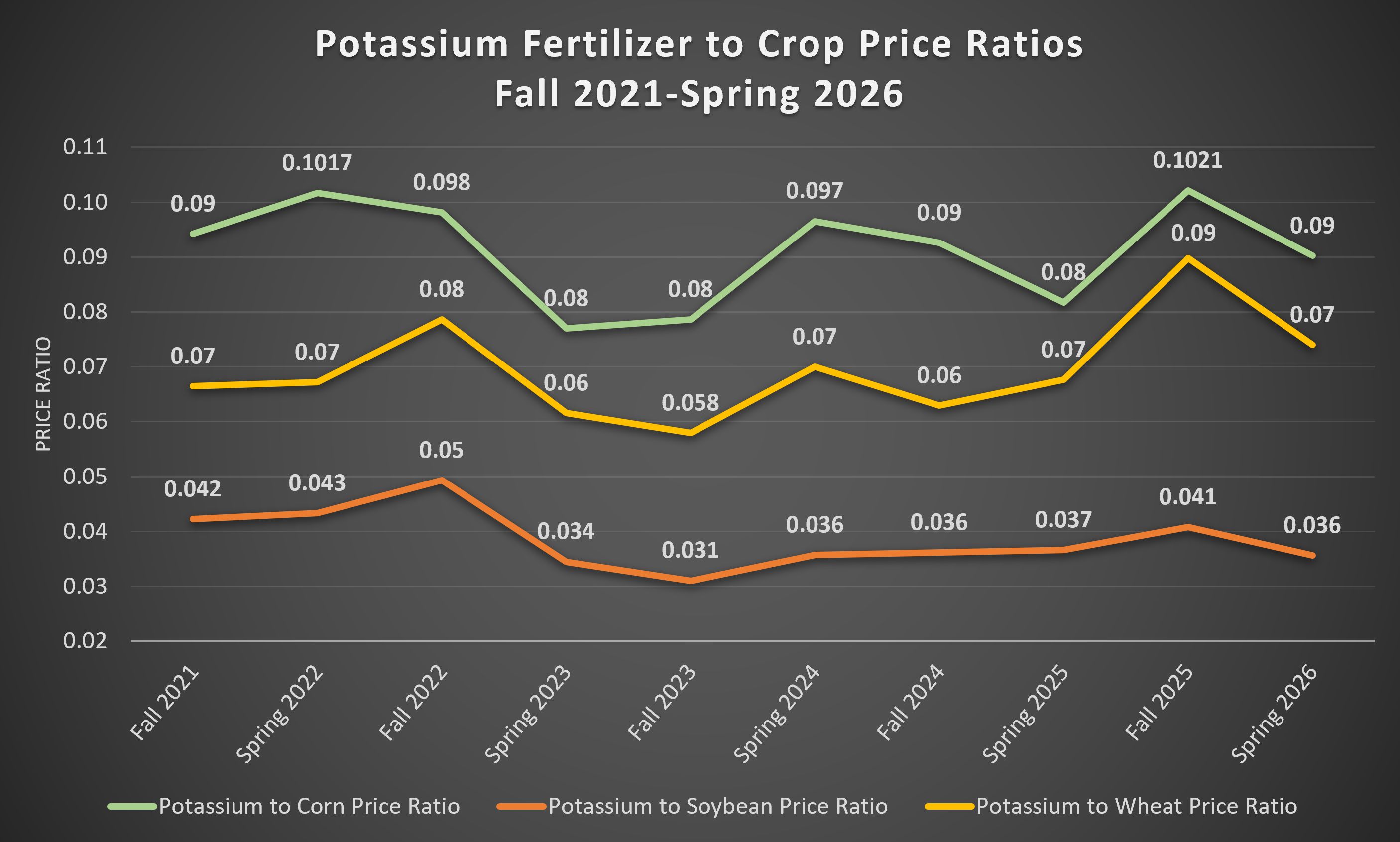
In Figure 2, the fertilizer-to-crop price ratio indicates that potassium fertilizers were less expensive in the fall of 2021 and 2023 compared to each following spring. The fall of 2024 was also less expensive than the following spring for soybeans and wheat.
A partial explanation for differences between ratios for the three crops seen in Figures 1 and 2 is the direction of commodity prices and fertilizer costs during those periods. Commodity and fertilizer prices both rose steadily from 2021 through 2022 before commodities began to decline in value in 2023. As fertilizer prices remained elevated in the following years, the level of fertilizer expense compared to the crop value began to increase dramatically. Corn acres were among the most impacted by the shift in fertilizer and commodity prices.
Supply was also an additional factor for the shift in fertilizer to crop price ratio for phosphorus. For much of the past five years, several key exporting countries have limited their supply of phosphorus. Supply continues to be a factor for phosphorus and places some upward pressure on commodity prices to cover the elevated fertilizer costs. On the other hand, potassium supplies and prices have remained fairly steady during the same period.
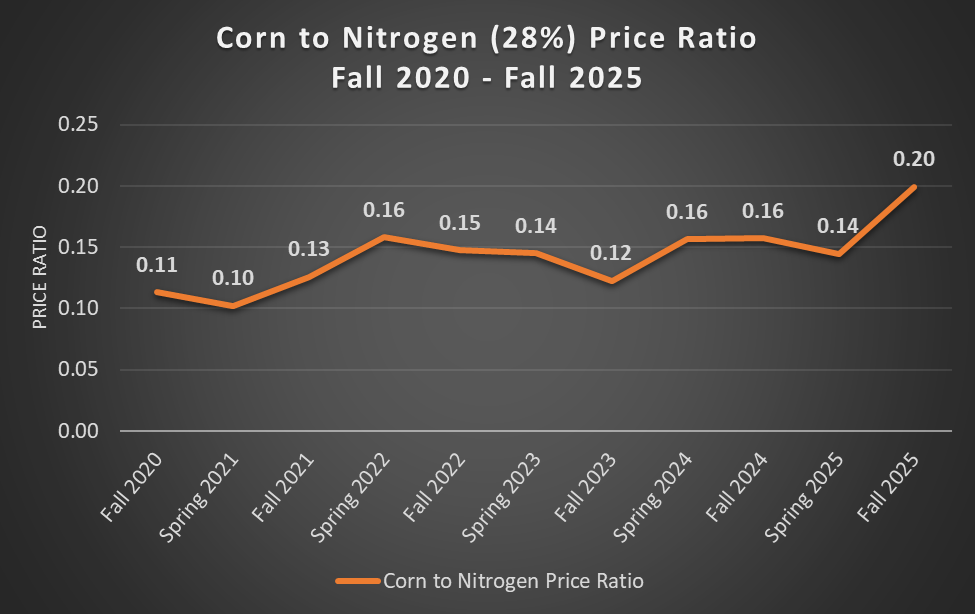
With such high price ratios in recent years, producers may be tempted to chance waiting until spring to make any fertilizer purchases. However, even if purchases are not made until spring, it’s important to consider month-to-month differences in the crop-to-fertilizer price ratios. Especially in periods where heightened volatility may exist in the market (Figures 3 & 4).
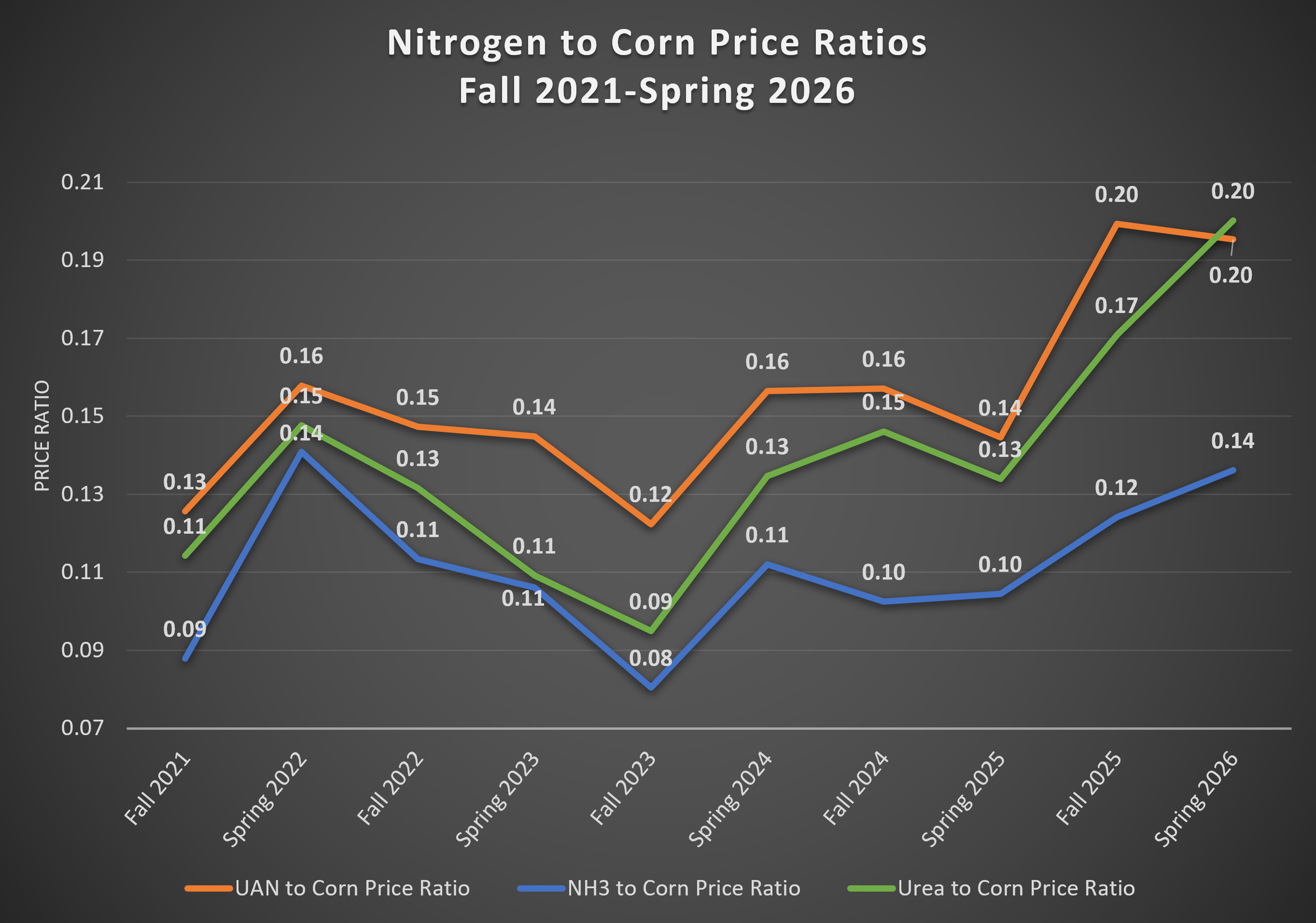
In Figure 3, producers in 2021/2022 were better off if nitrogen purchases were made in the fall versus the spring (for example, UAN had a ratio of 0.13 in fall versus 0.16 in spring). The opposite was true for 2024/2025 when purchases were better in spring compared to fall (UAN ratio of 0.16 in fall versus 0.14 in spring). For the recent 2025/2026 buying season, it was a mix ── whether producers were better off purchasing in the fall versus spring depended on the nitrogen product. With a ratio of 0.20 for fall and spring, UAN nitrogen remained at an all-time high expensive level compared to corn prices in both periods. For Urea, producers purchasing in the fall saw a 0.17 ratio compared to the 0.20 ratio in the spring. Similarly, Anhydrous Ammonia (NH3) saw a ratio of 0.12 in the fall compared to 0.14 in the spring.
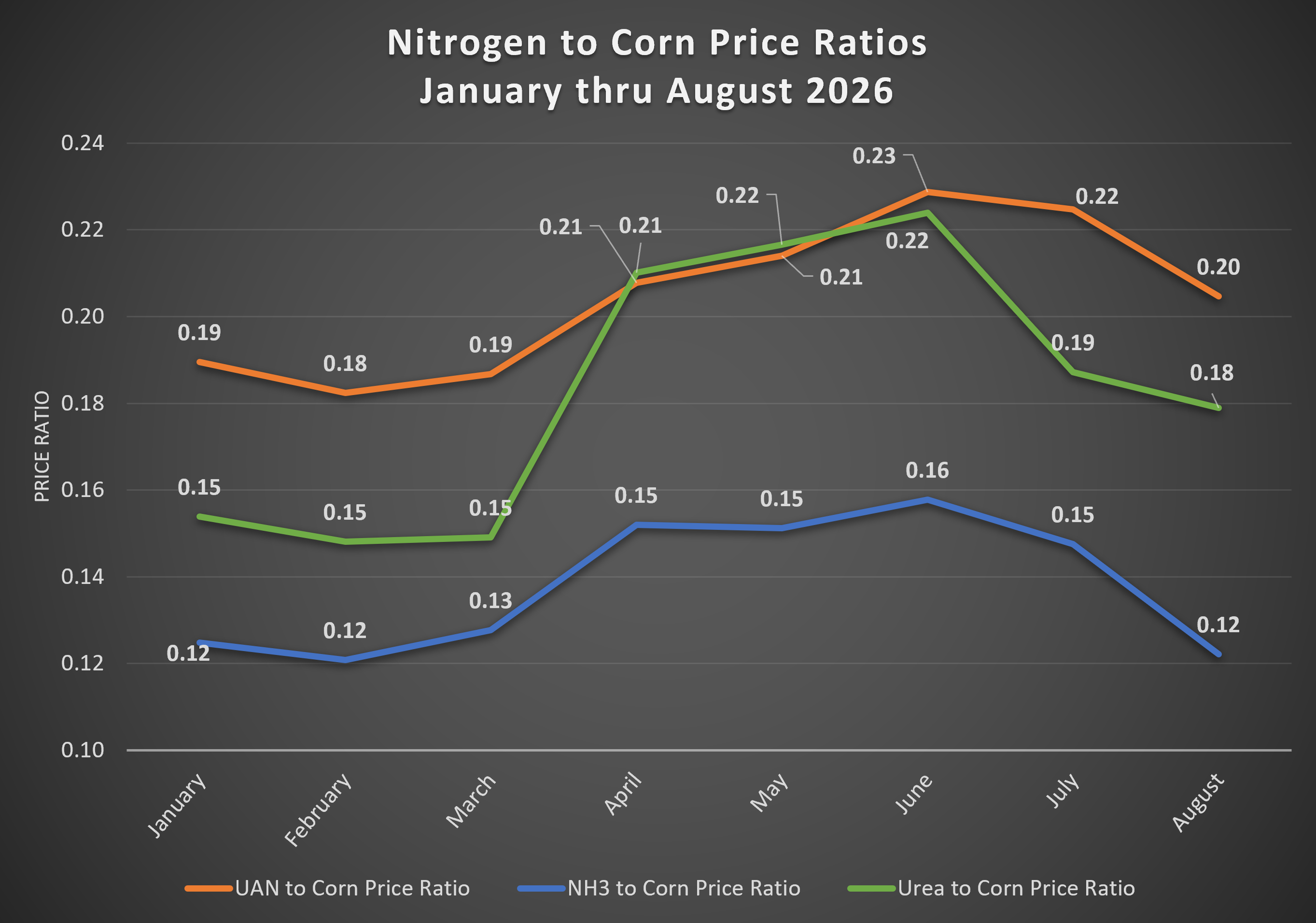
In Figure 4, monthly corn-to-nitrogen price ratios highlight the volatile nature that global supply chain disruptions can have on fertilizer expenses. Since February, the Strait of Hormuz in the Middle East has been effectively closed due to the ongoing conflict between the United States and Iran. The strait is a major supply lane for shipments of urea-based fertilizers. In particular, supplies for urea were significantly reduced during the peak demand months of April through June. The result was a dramatic increase in the price of urea-based fertilizers during those months. Cash corn prices fluctuated between $4.09 to $4.57 per bushel on average during this period, which provided only partial relief for the increased costs. For example, in June the price of corn in Michigan averaged $4.38 per bushel. UAN saw an average price of $561 per ton and a corn to nitrogen ratio of 0.23, which was UAN’s highest corn-to-nitrogen ratio on record for the past five years.
Both Figure 3 and Figure 4 help to illustrate the importance of spreading out all farm input purchases, not just fertilizer, between fall and spring. If at least some fertilizer was purchased in fall of 2025, it would have helped offset the volatility experienced in spring 2026. More importantly, consider pricing opportunities from month to month in those periods. Especially if global or domestic uncertainty on product prices and availability are on the rise.
Purchasing a certain amount of inputs over several months in the fall can provide several advantages, such as utilizing storage and ensuring some products are on hand. Some fall purchases, when balanced with purchases in spring months, can also keep overall prices paid lower. You may not buy all of your inputs at the lowest prices with this strategy, but you avoid buying all your inputs at the highest prices.
Also consider what products your cash flow might let you easily purchase in fall months. Then identify key months to secure remaining purchases in the spring that align with your crop plan.
Identifying needs and maximizing cash
Each year you develop a crop plan that identifies what you will grow. While crop plans are not a new concept for most farms, they are an important part of maximizing your use of available cash. Cash is often limited to working capital or loan funds. Since they are used for numerous purchases throughout the year, efficient use of these dollars is important.
Prioritizing products to buy
Equally important as maximizing your use of cash is prioritizing products you’ll buy first. Your crop plans, capital investments you’ve made, and market conditions are all key components of this process. For example, better discounts often exist for seed purchases in the fall versus the spring. While discounts for chemicals may start in late fall or early spring.
To help weigh product options, consider utilizing decision tools offered by MSU Extension at the Farm Business Decision Tools website.
Create an input purchasing plan
An input purchasing plan takes your crop plan and adapts it into an efficient buying strategy to obtain products at affordable costs. Borrowing from grain marketing concepts, input purchasing focuses on being intentional and proactive about buying decisions. Learn more about input purchasing plans.
MSU Extension Bulletin E-3508: Strategies for Purchasing Farm Inputs
Further information on these concepts can be found in MSU Extension Bulletin E-3508: Strategies for Purchasing Farm Inputs. The bulletin offers insight into strategic approaches to buying farm inputs and explores how to secure products at reasonable prices by creating an input purchasing plan.
Bulletin E-3508: Strategies for Purchasing Farm Inputs
This resource is offered through the MSU DEMaND Series, which helps the next generation of farm operators learn about financial and business management strategies.

