Are you still getting benefits from late planted cover crops?
 Print
 Email
How late is too late to reap benefits from fall planted cover crops?
When planting fall cover crops, often fall weather and harvest progress can interfere with the best laid plans for timely cover crop seeding. This leaves many producers asking, how late is too late to see a benefit?
The answer is not as simple as a date on a calendar but rather determined by soil temperature and soil moisture.
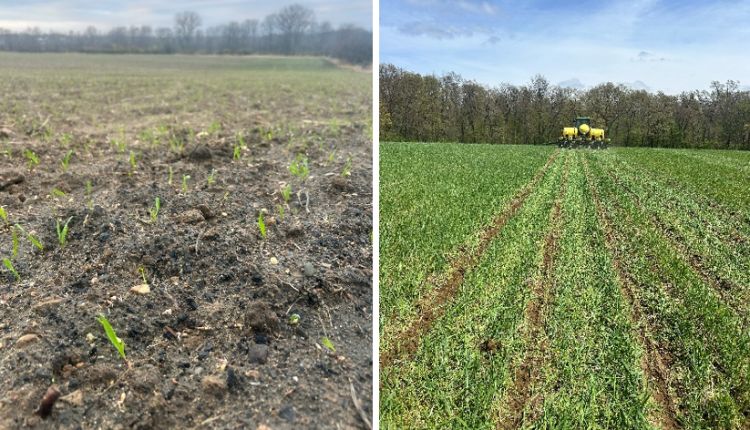
Soil moisture and good seed-to-soil contact are crucial for late fall cover crop establishment. Germination is delayed when planting seed into dry soil, especially if broadcasting. If soil is dry and rain is not in the forecast, consider drilling the cover crop. Winter grains do not need a strong stand in the fall to survive and resume growth in the spring. As long as the seeds have absorbed enough moisture to germinate and establish belowground growth before winter, they can continue developing in the spring.
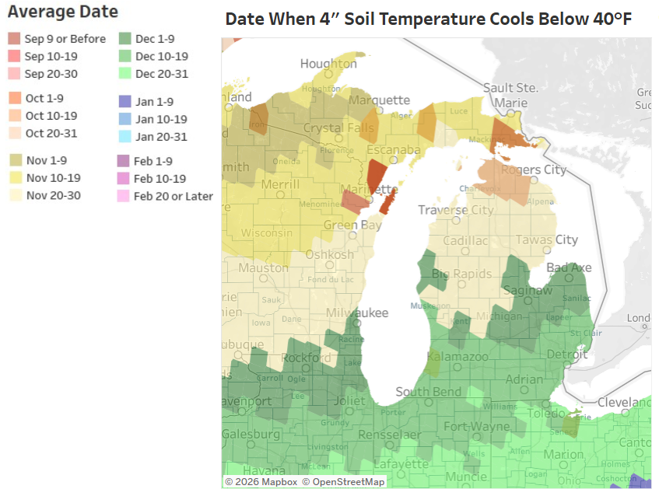
While warmer soil temperatures may optimize germination, some cover crops can germinate at lower soil temperatures, which is what we will be focusing on for the November planted cover crops. In an average year, soil across Michigan’s Lower Peninsula remains above 40 degrees Fahrenheit until late November with southern counties remaining above 40 F until mid-December (Figure 1, Midwest Regional Climate Center).
According to MSU Enivoweather, as of Nov. 2, 2026, the entire state is still above the minimum soil temperature for germination of these winter cereals, though much of the Upper Peninsula and Upper Northern Michigan are getting closer to those minimums.
If you are planting cover crops in November in Michigan, winter grains are the way to go. They have a lower soil temperature required for germination, are tolerant of cold and continue to grow the following spring after a period of vernalization over winter.
While planting cover crops later may limit fall growth and thus some of the fall and winter benefits, winter cereals continue to grow in spring. This spring growth allows them to help reduce spring erosion and control weed pressure until it is terminated shortly before planting. This spring growth also helps build soil organic matter.
The following is more information on how November-planted winter cereal grains may perform as a cover crop.
Cereal rye
Cereal rye is considered one of the best cover crops for planting in November. Its minimum soil temperature requirement for germination of 34 F is lower than other options. Cereal rye is cold hardy and typically considered one of the most winter hardy winter cereals.
Even if rye doesn’t establish a great stand in the fall and loses some of the fall benefits such as scavenging residual nitrogen from the crop, it grows rapidly in the spring, allowing its benefits to shine through at that time. These benefits include excellent weed suppression, good erosion control and increased soil organic matter when the crop is terminated and incorporated into the soil.
When allowing rye to overwinter, termination is key in the spring as rye becomes harder to terminate as it quickly grows. When using cereal rye as a cover crop before corn, terminate the rye before it matures to avoid hindering the emerging corn crop.
It is typically recommended to terminate the rye at 8-12 inches tall via mechanical or chemical control. If the intended termination method is roller crimping to use the mulch for weed control, then the rye needs to grow until it reaches anthesis (flowers at the top of the head across the whole field). If rye is roller crimped too soon, the plant may not terminate.
For more tips on roller crimping, check out the resource “Roller Crimping to Terminate Cereal Rye Cover Crop in Michigan” from Michigan State University Extension.
Winter wheat and triticale
Winter wheat and triticale are also excellent choices for late cover crop planting. The minimum soil germination temperature of 38 F, which is a couple degrees warmer than that of cereal rye, allows for a little less flexibility. They have good winter hardiness, though slightly less winter hardy than cereal rye.
Like cereal rye, even if there is limited fall growth from late-planted winter wheat or triticale, spring growth still provides benefits. Some of the benefits of wheat/triticale include good weed suppression, erosion control, and building soil organic matter.
Wheat and triticale are slower to grow in spring than rye but even the slower growth is better than no living cover. The advantage of being a slower grower in spring is they are easier to control and terminate appropriately than a cereal rye cover.