2027 Aquaculture Challenge registration open
 Print
 Email
Registration is now open for a competition that engages middle- and high-school students in STEM learning, innovation, and career development by designing and building classroom aquaponics systems.
Registration is now open for a competition that engages middle- and high-school students in STEM learning, innovation, and career development by designing and building classroom aquaponics systems.
Michigan Sea Grant co-chairs the Aquaculture Challenge, a collaboration between the Great Lakes Sea Grant Network and Lake Superior State University (LSSU). This science competition engages students in grades 6-12 from around the Midwest in a four-month venture to:
- Build and monitor aquaponics systems;
- Create business plans; and
- Educate their community about seafood.
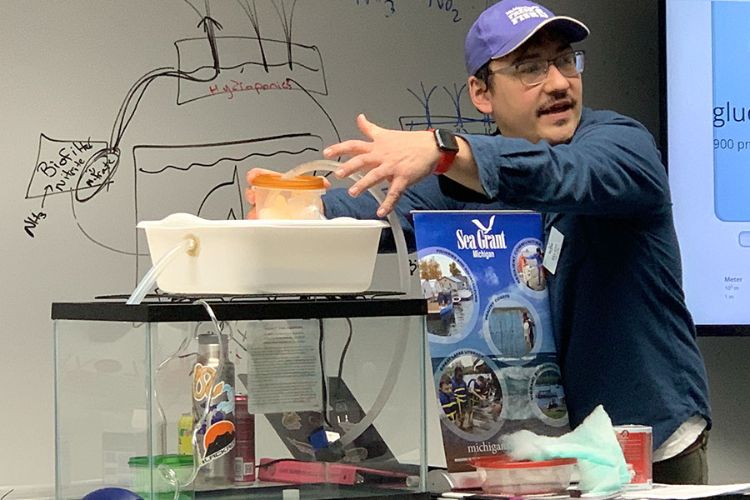
Aquaponics provides a way to raise fish and plants in a single system. Fish grow in one section of the system, and water cycles the nutrients from their waste to feed plants elsewhere in the system. These closed loops can operate at many different scales, making them ideal for classroom experiments.
Michigan Sea Grant and Michigan State University Extension educator, Elliot Nelson, recently spoke with TV6’s Molly Birch about the opportunities this challenge provides to students in the Upper Peninsula and beyond.
“I used to be a high school science teacher,” he said, “And some students really thrive with hands-on time where they can be creative. This process allows them to design and build their own systems with a purpose — and they get to decide that purpose.”
Nelson continued, “The students get to design it however they want, and they decide what to grow.” Previous Aquaculture Challenge teams have created systems that housed everything from turtles and spider plants to cucumbers and tilapia, carrots, mint, and strawberries.
Since the Aquaculture Challenge began in 2016, thousands of students from around the Great Lakes region have engaged in STEM learning, built project management and leadership skills, and explored potential career paths in aquaculture and aquaponics.
Nelson said that the challenge is “very hands-on” and integrates a lot of complex biology, engineering, and plumbing, which helps develop many good, practical skills.
Students also learn about the importance of seafood, in a nation that imports 80% of the seafood we consume. Participants learn about the possibility of growing our own more locally.
He concluded, “We’ve been doing this event for almost 10 years, and every single year, I am blown away by two things. One, how creative students are. One time we had a fully automated system that a student programmed to be able to control with an app on their phone, and they did that all on their own. I also love seeing how engaged the students are, particularly non-traditional STEM students who might struggle with science. They tend to find this kind of hands-on activity really engaging.”
The Aquaculture Challenge is open to teams of students in grades 6-12 with an adult coach or captain. Teams can come from rural, urban, and suburban schools or homeschool groups in Michigan and surrounding Great Lakes states. New and returning teams are welcome; Michigan Sea Grant staff provide start-up guidance and resources for coaches before the competition cycle begins each January. Registration closes January 15, 2027.