


Final Thesis Defense Crop and Soil Science Ph.D. Degree Candidate’s Name: CHENXI LI
November 23, 2026 12:00PM - 1:00PM
Date: November 23, 2026
Time: 12:00 pm to 3:00 pm
Location: PSSB 279
Application and Impacts of Amendments in Soil-Crop Systems: Microbial Activities in Maize Soils and Metal Accumulation in Carrots
Members of the Examining Committee and their Department:
- Dr. Wei Zhang - Plant, Soil and Microbial Sciences
- Dr. Hui Li - Plant, Soil and Microbial Sciences
- Dr. Kurt Steinke - Plant, Soil and Microbial Sciences
- Dr. Zachary Hayden – Horticulture
ABSTRACT
Soil amendments are widely used in agriculture to improve soil quality and nutrient availability and to manage the accumulation of essential and toxic metals in crops. Their effects on soil microbial activities and crop elemental composition are important to soil functioning, crop nutrition, and food safety. These effects may vary with amendment types, application practices, and interactions between soils and plants. Using maize (Zea mays L.) and carrots (Daucus carota subsp. sativus) as model crops, this dissertation assessed how amendments influence soil microbial activities and nutrient acquisition in maize soils and the uptake and accumulation of metals in carrots.
The first study assessed how biosolids-derived amendments, including thermally dried pelletized biosolids, dewatered cake, digestate, and pyrolyzed biochar, influenced extracellular enzyme activities, microbial communities, and nitrogen-cycling genes in maize soils, compared with slow-release nitrogen fertilizer and an unamended control. Pelletized biosolids enhanced carbon- and nitrogen-acquiring enzyme activities and increased the diversity and carbon-normalized intensity of total enzymatic potential, whereas digestate reduced enzymatic activity. Carbon-to-nitrogen and carbon-to-phosphorus acquisition ratios were strongly correlated, possibly due to coupling of microbial nutrient acquisition. Microbial communities and nitrogen-cycling genes in subsurface soils showed corroborating hierarchical clustering patterns.
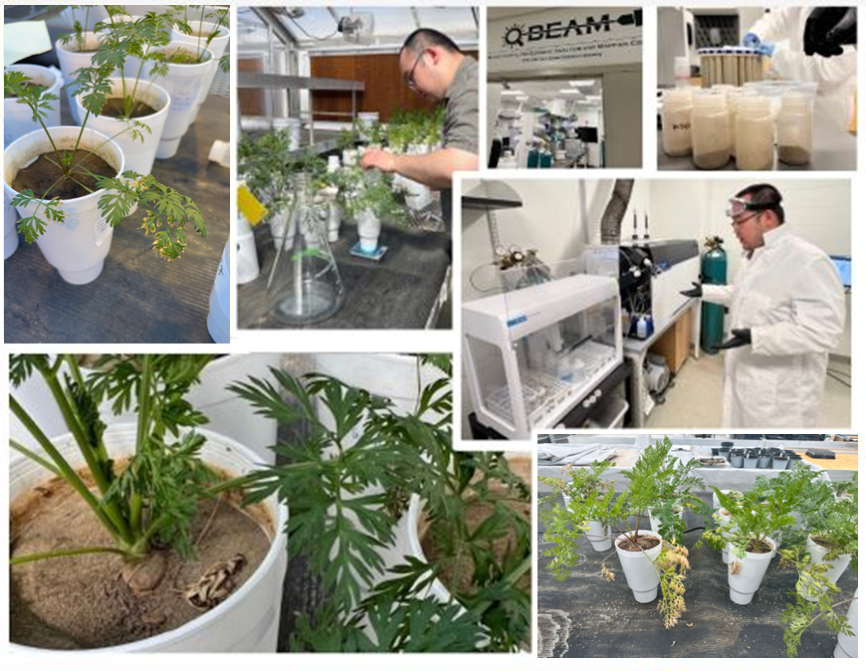
The second study examined how eight amendments applied individually at 0.50% by weight influenced the uptake and accumulation of eleven metals in the roots and shoots of carrot seedlings grown in sandy soil. Metal accumulation in carrot roots was sensitive to amendment application, but the responses differed among metals and amendments. Arsenic (As), cadmium (Cd), cobalt (Co), iron (Fe), manganese (Mn), and zinc (Zn) showed strong and consistent correlations in carrots, suggesting potential coordinated uptake or translocation, whereas chromium (Cr), nickel (Ni), and selenium (Se) were absent from the correlation networks. Amendments primarily influenced non-correlated metals in roots, while correlated metals remained largely unaffected. Relationships between extractable metals in pre-growth and post-growth soils and their accumulations in carrots also suggested the influence of plant on carrot metal uptake.
The third study investigated the composition of eighteen metals in carrots and associated metabolic responses in storage roots following the application of biochar, gypsum, zeolite, and wood ash, individually or in mixtures, at a total rate of 0.30% by weight. Gypsum-containing treatments approximately doubled Cd concentrations in storage roots without increasing extractable Cd concentrations in soils. Biochar-gypsum combinations increased Ni, Co, Cu, and Zn concentrations in storage roots, which did not occur with either amendment alone. Metabolite patterns corresponded with metal accumulation patterns in carrots, with methionine sulfoxide following Cd patterns and methionine-related metabolites following Ni, Co, Cu, and Zn patterns.
Overall, amendment effects on soil microbial activities and crop metal accumulation depend on amendment types, application practices, and biological responses within soil-crop systems. Importantly, changes in extractable metal concentrations in soils did not consistently reflect changes in their accumulation in edible roots, and amendment mixtures produced responses that differed from individual applications. Future studies that evaluating soil microbial functioning together with crop metal composition and metabolic responses could support the development of amendment practices that improve soil quality while protect crop nutrition and food safety.
 Print
 Email